Contributor(s): Shared on: Categories: Tags: | Source (Hebrew) | Translation (English) |
|---|
אָבִֽינוּ שֶׁבַּשָּׁמַֽיִם.
עֲשֵׂה רְצוֹנְךָ בַּשָּׁמַֽיִם מִמַּֽעַל.
וְתֵן נַֽחַת רֽוּחַ לֽירֵאֶֽיךָ מִתָּֽחַת.
וְהַטּוֹב בְּעֵינֶֽיךָ עֲשֵׂה. (ברכות כט ב׳) |
Our Heavenly Father.
Carry out your will in the heavens above,
and give peace of mind to those who fear you below,
and perform that which is good in your eyes. (Berakhot 29b.11) | |
Unto thee, Heavenly Father,
I lift up my heart in this hour of trial and danger.
Pardon all my sins and transgressions before thee;
and, I beseech thee,
extend thy loving care over the lives of those near and dear unto me.
Give me the strength to do my duty this day
as a true and loyal Israelite in this War for Freedom and Righteousness.
Fill me with the faith and courage
of those who put their trust in thine everlasting mercy;
and lead us through victory unto peace.
May thy will be done. |
בָּרוּךְ אַתָּה יְיָ שׁוֹמֵֽעַ תְּפִלָּה׃ |
Blessed art thou, O Lord, Who hearest prayer. |
בְּיָדְךָ אַפְקִיד רוּחִי.
פָּדִֽיתָה אֹתִי יְיָ אֵל אֱמֶת׃ |
Into thy hand I commend my spirit;
thou hast redeemed me, O Lord God of truth. |
שְׁמַע יִשְׂרָאֵל יְיָ אֱלֹהֵינוּ יְיָ אֶחָד׃
בָּרוּךְ שֵׁם
כְּבוֹד מַלְכוּתוֹ לְעוֹלָם וָעֶד׃ |
Hear, O Israel, the Lord our God, the Lord is One.
Blessed be his name,
whose glorious kingdom is for ever and ever. |
אָמֵן׃ |
Amen. |
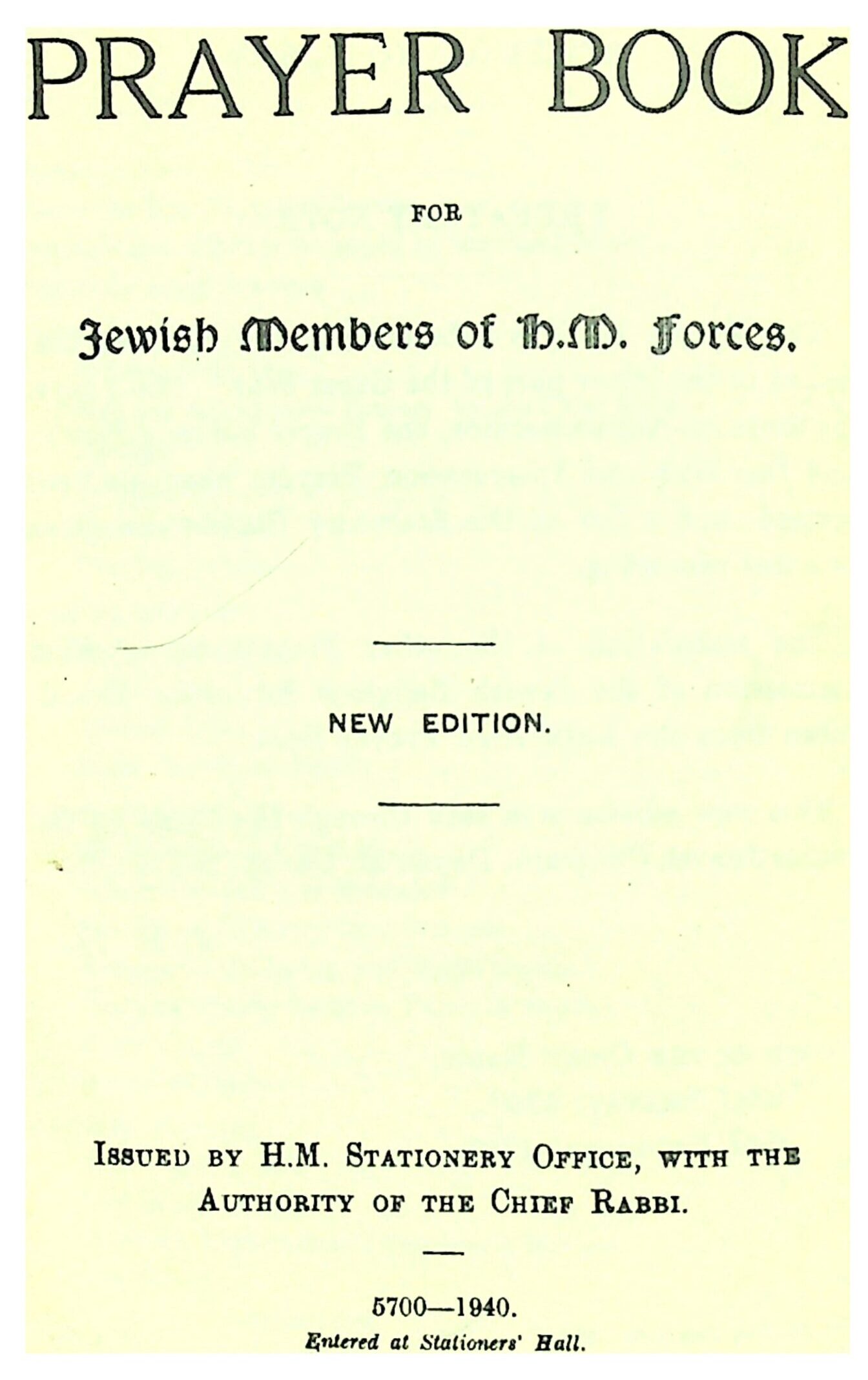
“Prayer Before a Battle” appears at the start of Prayer Book of Jewish Members of H.M. Forces (Office of the Chief Rabbi 1940), p. 5. It was likely authored by either Rabbi Joseph H. Hertz or Rabbi Dayan Mark Gollop. If you know for certain, please leave a comment or contact us. –Aharon Varady Source(s)
Joseph Herman Hertz (25 September 1872 – 14 January 1946) was a Hungarian-born rabbi and biblical scholar. He is most notable for holding the position of Chief Rabbi of the United Kingdom from 1913 until his death in 1946, in a period encompassing both world wars and the Holocaust. Hertz edited a notable commentary on the Torah (1929–36, one volume edition 1937). Popularly known as the Hertz Chumash, this classic Hebrew-English edition of the Five Books of Moses, with corresponding Haftorahs, is used in synagogues and classrooms throughout the English-speaking world. He also edited a Hebrew-English edition of the Jewish Prayer Book or Siddur (1946), and contributed to the Jewish Encyclopedia and the Encyclopædia Britannica.  The Office of the Chief Rabbi is the institutional identity for the Chief Rabbi of the United Hebrew Congregations of the Commonwealth [UK]. Unlike in other European countries, individuals serving as the Chief Rabbi of the United Hebrew Congregations are not formally designated by an authoritative state or civic body. Rather, the "office" is occupied by the senior rabbi of the United Synagogue, the umbrella institution for its affiliated Orthodox and Ashkenazi synagogues in the United Kingdom. The position of Chief Rabbi in the UK grew out of an 18th century desire among British Jewry for a respected representative figure comparable to the Archbishop of Canterbury for Anglican Christians. Rabbi Aaron Hart (1670–1756), rabbi of the Great Synagogue in London since 1704, was thus regarded by the 1750s as the first of the British chief rabbis. Over the next century and as British Jewry continued to grow, by the tenure of Rabbi Nathan Marcus Adler (from 1845-1890) the communal leadership and halakhic authority of the position had become firmly established. When in 1870, the Great Synagogue joined with four other synagogues, and was formally recognized as the United Synagogue by an Act of Parliament, the Chief Rabbi was legally established as its head. The current chief rabbi of the UHC and senior rabbi of the United Synagogue is Rabbi Sir Ephraim Mirvis. (The Office of the Chief Rabbi should not be mistaken for the London Beit Din, the Court of the Chief Rabbi of the United Hebrew Congregations.) Aharon Varady (M.A.J.Ed./JTSA Davidson) is a volunteer transcriber for the Open Siddur Project. If you find any mistakes in his transcriptions, please let him know. Shgiyot mi yavin; Ministarot naqeni שְׁגִיאוֹת מִי־יָבִין; מִנִּסְתָּרוֹת נַקֵּנִי "Who can know all one's flaws? From hidden errors, correct me" (Psalms 19:13). If you'd like to directly support his work, please consider donating via his Patreon account. (Varady also translates prayers and contributes his own original work besides serving as the primary shammes of the Open Siddur Project and its website, opensiddur.org.) Read a comment / Leave a comment (moderated) Works of related interest: |
![the Open Siddur Project [logo]](https://opensiddur.org/wp-content/uploads/2018/09/Open-Siddur-Project-Logo-2016.svg)









Leave a Reply