Contributor(s): Shared on: 30 December 2025 under the Creative Commons Zero (CC 0) Universal license a Public Domain dedication Categories: Tags: | Contribute a translation | Source (English) |
|---|
|
Conscious of the vast universe, O God,
in which our earth is smaller than a grain of sand,
and our life less than a fleeting moment,
we are filled with awe and reverence,
and with bowed heads tremblingly
stand before Thee.
The greatness to which we lay claim,
the achievements of which we are proud,
the ambitions which dazzle our eyes,
fade away in utter insigniflcance before Thy presence.
Humility fills our being
and such humility is the beginning of wisdom. | |
Under its influence
may those who have gathered here
to plan for the welfare of our republic
cast aside all selfish consideration,
all pride and vain glory.
May conviction and principle
and not careerism and the desire for power animate them.
In these days of storm and stress,
when millions of human beings languish in despair
and lead a tortured existence on the abyss of want and of misery,
let all other considerations but their well-being be secondary.
May the spirit of the ancient prophets permeate this assemblage,
that their sympathy for the underprivileged,
their passion for social justice,
and their recognition of human brotherhood
may be recorded in its decisions. | |
O our God,
purge us of national arrogance and vanity.
Help us to recognize,
that we are members of the family of nations,
and no complete happiness can be ours
unless that happiness is shaded by all men.
Destroy then in our souls
the petty, the base and the selfish,
which alienate us from our fellow-men
and from Thee. | |
Help us, O God,
to select for the highest offices
men of rugged character
and lofty idealism,
through whose ministration
mankind’s faltering trust in democracy
may be sustained. | |
Our souls overflow with gratitude to Thee
for the marvelous land which we inhabit,
for its fertile fields
and rolling plains,
for its beetling hills
and for its coursing streams.
Truly Thou hast been generous with us.
May we be equally generous
in administering Thy bounty
in the interests of all. | |
May we Americans,
true to the ideals of the founders of our nation,
renew our allegiance
to the principles of religious, political and economic freedom.
May we march forth to the four corners of our country
to dissipate the clouds of despair and gloom
and thus strengthen the faith of our fellow-citizens
in the ultimate establishment of Thy kingdom
of righteousness and peace. | |
May such hopes and motives guide this convention
so that through its work all men will benefit
and Thy name, O God, be magnified
throughout all the earth.
We hope, and with courage,
with faith in humanity
and with idealism in our souls,
let us carry on the heritage of the ages.
Amen. |
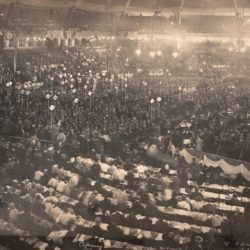
This is the invocation of Rabbi Ferdinand M. Isserman offered at the Republican National Convention in Chicago, Illinois on 16 June 1932, as found in The Washington Times, “The Rabbi Prayes for Nation’s Needy at Convention.” Many thanks to Howard Mortman for bringing this prayer to our attention. Source(s)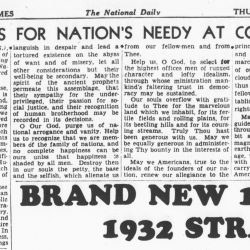 Rabbi Prays for Nation’s Needy at Convention (Ferdinand Isserman in The Washington Times 16 June 1932)
Aharon Varady (M.A.J.Ed./JTSA Davidson) is a volunteer transcriber for the Open Siddur Project. If you find any mistakes in his transcriptions, please let him know. Shgiyot mi yavin; Ministarot naqeni שְׁגִיאוֹת מִי־יָבִין; מִנִּסְתָּרוֹת נַקֵּנִי "Who can know all one's flaws? From hidden errors, correct me" (Psalms 19:13). If you'd like to directly support his work, please consider donating via his Patreon account. (Varady also translates prayers and contributes his own original work besides serving as the primary shammes of the Open Siddur Project and its website, opensiddur.org.)  Ferdinand M. Isserman (1898-1972), born in Antwerp, Belgium, was a Reform movement rabbi in the United States. His family immigrated to the United States in 1906, settling in Newark, New Jersey, In 1914, Isserman entered Hebrew Union College (HUC), in conjunction with the University of Cincinnati, he studied for his bachelor's degree while training for the rabbinate. In 1917, he received a Bachelor of Hebrew Letters degree from HUC. In 1919, Isserman completed the requirements for a bachelor's degree from the University of Cincinnati and three years later (June 1922) he was ordained a rabbi. While in school, Isserman participated in various extra-curricular activities. He was on both the University of Cincinnati and the HUC basketball teams (lettering in basketball at the University of Cincinnati), he served as president of the HUC Literary Society in 1920-1921, and in 1921-1922 he was president of the HUC student body. Upon ordination, Isserman became Assistant Rabbi under Rev. Dr. Harry W. Ettelson at Rodeph Shalom Congregation in Philadelphia, Pennsylvania. He remained in this position for three years, during which he Studied at the University of Pennsylvania, receiving a Master of Arts degree in comparative religion in 1924. In 1925, Isserman assumed the position of rabbi of the Toronto Hebrew Congregation ("Holy Blossom") in Canada. In Toronto, Isserman distinguished himself by arranging Canada's first pulpit exchange between a Christian minister and a Jewish rabbi. In 1929, Isserman became rabbi of Temple Israel in St. Louis, Missouri, where he remained through 1963. Isserman visited Nazi Germany three times (in 1933, 1935 and 1937) and participated in many civic as well as Jewish oriented organizations. Some of his more prominent activities included: conducting weekly Jewish programs on local radio stations (1932-1963), holding an annual Institute on Judaism for the Christian Clergy at Temple Israel (1937-1962), serving as president of the University of Missouri Jewish Student Foundation (1940-1947), spending one year overseas during World War Ⅱ with the American Red Cross (1943), serving as first president of the combined Hebrew Union College-Jewish Institute of Religion Alumni Association (1950-1951), chairing both the American Jewish Tercentenary Committee of St. Louis and the American Jewish Tercentenary Committee of Missouri (1954), serving as the American chairman of the World Union for Progressive Judaism (1955-1956), and chairing the Thomas C. Hennings Jr. Memorial Committee (1960). He was very active with the CCAR's Commission on Justice and Peace from 1942 through 1950, serving as chairman from 1942 through 1945. In 1942, Isserman helped organize and presided over the Commission's American Institute on Judaism and A Just and Enduring Peace. In 1945 he organized the Commission's Institute on Judaism and Race Relations, and in 1950 he helped organize the CCAR's Institute on Reform Jewish Theology Today. Read a comment / Leave a comment (moderated) Works of related interest: |
![the Open Siddur Project [logo]](https://opensiddur.org/wp-content/uploads/2018/09/Open-Siddur-Project-Logo-2016.svg)










Leave a Reply