![the Open Siddur Project [logo]](https://opensiddur.org/wp-content/uploads/2018/09/Open-Siddur-Project-Logo-2016.svg)
| Contribute a translation | Source (English) |
|---|---|
Behold how good and how pleasant it is for brethren to dwell together in unity. (Psalms 133:1) | |
Our God and Father in Whom and through Whom we are brothers, one to the other, we lift our hearts in thanksgiving unto Thee for this, our dedication of the Tri-Faith Chapels Plaza, has a noble symbol and expression of our love of Thee and faith in our country’s commitment to freedom of worship and conscience. May the three Chapels erected to Thy greater glory serve as a reminder that all Thy children are bound together by a common destiny and common humanity. | |
We ask, now, Thy traditional benediction upon all assembled here this morning. The Lord bless us and keep us; the Lord cause His face to shine upon us and be most gracious unto us; the Lord cause His divine presence to dwell in our midst and grant us the most precious of all of His benedictions, the blessing of peace…[1] Find Numbers 6:24-26 peace in our hearts, peace in our homes, peace in our communities, and peace in the world. Amen. |
This is Rabbi Israel Mowshowitz’s benediction at the dedication of the “Tri-Faith Chapels Plaza” in Jamaica-Queens, New York on 18 December 1966, representing the New York Board of Rabbis. Specially designed chapel buildings were established for Jewish, Catholic, and Protestant religious groups across from the International Arrivals building at the JFK Airport. Benedictions were made by the chaplain responsible for each room: Rev. Dr. G. Barrett Rich, Ⅲ (Protestant); and Right Reverend Monsignor Francis X. Fitzgibbon (Catholic). Also speaking at the dedication was Hubert H. Humphrey, Vice President of the United States; and Samuel F. Pryor, chairman of the joint campaign to raise $1-million for the work establishing the plaza. The transcription was made from a taped recording of the event, a copy of which is held at the Minnesota Historical Society. Rabbi Mowshowitz’s benediction appears on the final page (p. 15) of this transcript. Many thanks to Howard Mortman for bringing this prayer to our attention.
The history of the Tri-Faith Chapel Plaza was shortlived. All three chapels were demolished in 1989 and new prayer spaces were incorporated into the International Arrivals Terminal building. From the “History of the Chapel at the International Synagogue at JFK website:
In 1988, the independent chapels were taken over by the right of eminent domain to make way for runway expansion and the Port Authority decided to incorporate the chapels within the International Arrivals Building. Since it was inconvenient for passengers and employees to reach the chapels by foot from the terminals the three buildings were torn down to be re-located within the new main building. From 1988 until 2001, the three faith groups shared one temporary chapel on the second floor while construction was taking place. Presently, there are four chapels (a Multi-Faith chapel was added,) side by side, on the fourth floor of the International Arrivals Terminal. Each chapel accommodates approximately fifty people.
Source(s)
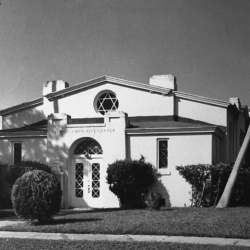
Israel Mowshowitz at the JFK Airport Tri-Faith Chapels Plaza dedication (18 December 1966), p. 15 synagogue interior at Tri-Faith Chapels Plaza Tri-Faith Chapels Plaza (from the air over JFK airport) Tri-Faith Chapels Plaza postcard


Notes
| 1 | Find Numbers 6:24-26 |
|---|
“Benediction at the Dedication of a Synagogue in the Tri-Faith Chapels Plaza of JFK Airport by Rabbi Israel Mowshowitz (18 December 1966)” is shared through the Open Siddur Project under the Creative Commons Attribution-ShareAlike (CC BY-SA) 4.0 International copyleft license.






Leave a Reply