![the Open Siddur Project [logo]](https://opensiddur.org/wp-content/uploads/2018/09/Open-Siddur-Project-Logo-2016.svg)
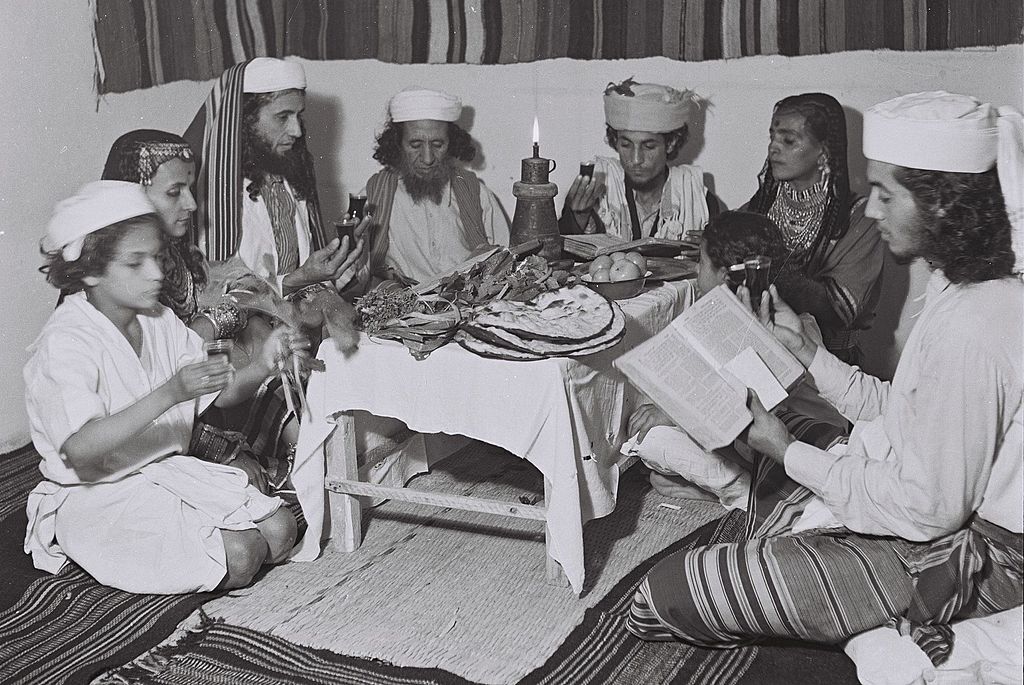
Born into Judaism, Paul Christian Kirchner was baptized a Christian in 1713. In 1717, he first published the work Jüdisches Ceremoniel (or “Jewish Ceremony”), for which he is most well known — a firsthand recollection (and, to be honest, criticism) of Jewish practices throughout the year and life cycle. While the work is written by an apostate for a Christian audience, and thus it is certainly not an unbiased source — and it had been almost a decade since he left the community so some of his memories are a bit muddled — it is still a fascinating work if only for its depiction of Jewish practices otherwise forgotten. In this portion of Kirchner’s description of the Seder night, he describes a ritual somewhat similar to the one still practiced in many North African communities to this day (found here) along with six — count ’em, six! — questions asked by the eldest (‽) child to the father.
Note: For clarity, we have replace the use of the Solidus (a/k/a “forward slash”) as found in the Fraktur script of the printed work, with its equivalent — the comma.
| Source (German) | Translation (English) |
|---|---|
Nachdem er davon getruncken[1] In modern German: getrunken , nimmt er den untersten Kuchen von der ersten Nacht Israel, und bricht denselben mitten von einander/und wickelt den halben Theil[2] In modern German: Teil in ein reines Hand-Tuch[3] In modern German: Handtuch , und hänget[4] In modern German: hängt es über die Achseln, als wie einer der reisen will, dabey[5] In modern German: dabei er sagt: Höret ihr Kinder! so seyn[6] In modern German: sein unsere Eltern eilends mit einem Stabe[7] In modern German: Stab und ungesäuertem Teige aus Egypten[8] In modern German: Ägypten von der Hand Pharao gegangen. |
After drinking from [the first cup], he takes the bottom loaf from the first night, Israel,[9] The loaves are referred to in the Jüdisches Ceremoniel as Chan (Kohen), Levi, and Israel. Note that in modern practice the middle matzo is broken, not the bottom one. This is likely a misremembering on the part of Kirchner. and breaks it in half, and wraps half of it in a clean handtowel, and hangs it over his shoulders, as if one were about to travel, and says: “Hear ye, children! This is how our ancestors hastily, carrying a staff and unleavened dough, went out from the hand of Pharaoh.” |
1.) Der älteste von dem Söhnen fragt: Vater, warum sind sie denn heraus gangen, wie du uns vorweisest? Darauf der Vater antwortet: Pharao drückte uns mit schwerer Arbeit, gab uns Wasser und Brodt,[10] In modern German: Brot doch ohne Wasser. Nachdem uns aber Gott die Gnade erwieß[11] In modern German: erwies , und uns durch Mosen ließ ausführen, nahm ein jedweder den Teig auf seine Achseln, und liess damit aus Egypten.[12] In modern German: Ägypten |
1.) The eldest[13] Note that the Four Questions are traditionally recited by the youngest son. This is likely another misremembering on the part of Kirchner. of the sons asks: “Father, why did they go out then, as you showed us?” After which the father answers: “Pharaoh oppressed us with hard labor, gave us water and bread, but without water. But after God showed us grace and allowed us to be led out by Moses, each of us took dough on his shoulders and left Egypt with it.” |
2.) Fragt der Sohn: Warum essen wir das Grüne von dem Rettig[14] In modern German: Rettich , sampt[15] In modern German: samt den Aepffeln,[16] In modern German: Äpfeln Nüssen und Zummet?[17] In modern German: Zimt Darauf der Vater antwortet: Unsere Eltern haben Stroh müssen hacken unter den Leim den gantzen[18] In modern German: ganzen Tag, und bedeutet das Grüne von Meerrettig[19] In modern German: Meerrettich das Stroh, das andere den Leim. |
2.) The son asks: “Why do we eat the green of the radish, along with the apples, nuts, and cinnamon?” The father replies: “Our parents had to chop straw under plaster all day, and the green of the horseradish represents the straw, the other part the plaster.” |
3.) [The son asks:] “Then why do we eat the horseradish?” The father answers: “The work came bitterly upon us, as did the bread, so we eat horseradish.” | |
4.) [Fragt der Sohn:] Warum essen wir Petersilge[23] In modern German: Petersilie in Saltz-Wasser[24] In modern German: Salzwasser eingetunckt[25] In modern German: eingetunkt oder in Eßig?[26] In modern German: Essig Der Vater sagt: Weil wir damahls[27] In modern German: damals nichts zu essen gehabt, als Graß[28] In modern German: Gras , das wir mit Eßig[29] In modern German: Essig angemacht. |
4.) [The son asks:] “Why do we eat parsley dipped in saltwater or vinegar?” The father says: “Because back then we had nothing to eat but grass, which we dressed with vinegar.” |
5.) [Fragt der Sohn:] Warum essen wir Eyer?[30] In modern German: Eier Darauff[31] In modern German: Darauf antwortet der Vater: Wanne[32] In modern German: Wenn einer von unsern Eltern gestorben, haben wir denselben Tag nicht dürffen[33] In modern German: dürfen kochen; sondern es haben uns Frembde[34] In modern German: Fremde ein wenig weisses[35] In modern German (excluding Switzerland): weißes Brodt,[36] In modern German: Brot Asche und Eyer[37] In modern German: Eier überschicket,[38] In modern German: überschickt und wir gedenken an die blutsaure und schwere Todes-Arbeit.[39] In modern German: Todesarbeit |
5.) [The son asks:] “Why do we eat eggs?” After which the father answers: “When one of our ancestors died, we would not be allowed to cook on that same day; instead, strangers sent us a little white bread, ashes, and eggs, and we would commemorate the bloody sour and arduous death-work.” |
6.) [The son asks:] “Why is there a piece of roasted meat upon the dish?” [The father answers:] “Because the paschal lamb[42] Literally: “Easter lamb.” Uncommon in modern German usage, at the time both Passover and Easter were referred to as such. This is still the case in many languages — see Greek Πάσχα των Ιουδαίων, French Pâque juive, Finnish juutalainen pääsiäinen, and Spanish pascua de los judíos. Note, though, that in all three of those languages, the word for Easter derives from the Hebrew פֶּסַח via Aramaic, which is not the case in German — or in English. was usually roasted.” |
Source(s)
Jüdisches Ceremoniel (Paul Christian Kirchner, 1717), p. 21 Jüdisches Ceremoniel (Paul Christian Kirchner, 1717), p. 22

Notes
| 1 | In modern German: getrunken |
|---|---|
| 2 | In modern German: Teil |
| 3 | In modern German: Handtuch |
| 4 | In modern German: hängt |
| 5 | In modern German: dabei |
| 6 | In modern German: sein |
| 7 | In modern German: Stab |
| 8 | In modern German: Ägypten |
| 9 | The loaves are referred to in the Jüdisches Ceremoniel as Chan (Kohen), Levi, and Israel. Note that in modern practice the middle matzo is broken, not the bottom one. This is likely a misremembering on the part of Kirchner. |
| 10 | In modern German: Brot |
| 11 | In modern German: erwies |
| 12 | In modern German: Ägypten |
| 13 | Note that the Four Questions are traditionally recited by the youngest son. This is likely another misremembering on the part of Kirchner. |
| 14 | In modern German: Rettich |
| 15 | In modern German: samt |
| 16 | In modern German: Äpfeln |
| 17 | In modern German: Zimt |
| 18 | In modern German: ganzen |
| 19 | In modern German: Meerrettich |
| 20 | In modern German: Meerrettich |
| 21 | In modern German: Brot |
| 22 | In modern German: Meerrettich |
| 23 | In modern German: Petersilie |
| 24 | In modern German: Salzwasser |
| 25 | In modern German: eingetunkt |
| 26 | In modern German: Essig |
| 27 | In modern German: damals |
| 28 | In modern German: Gras |
| 29 | In modern German: Essig |
| 30 | In modern German: Eier |
| 31 | In modern German: Darauf |
| 32 | In modern German: Wenn |
| 33 | In modern German: dürfen |
| 34 | In modern German: Fremde |
| 35 | In modern German (excluding Switzerland): weißes |
| 36 | In modern German: Brot |
| 37 | In modern German: Eier |
| 38 | In modern German: überschickt |
| 39 | In modern German: Todesarbeit |
| 40 | In modern German: Osterlamm |
| 41 | In modern German: meistenteils |
| 42 | Literally: “Easter lamb.” Uncommon in modern German usage, at the time both Passover and Easter were referred to as such. This is still the case in many languages — see Greek Πάσχα των Ιουδαίων, French Pâque juive, Finnish juutalainen pääsiäinen, and Spanish pascua de los judíos. Note, though, that in all three of those languages, the word for Easter derives from the Hebrew פֶּסַח via Aramaic, which is not the case in German — or in English. |
“Six Questions for the Seder Night, as recalled by Paul Christian Kirchner in his Jüdisches Ceremoniel (Nuremberg, 1717)” is shared through the Open Siddur Project under the Creative Commons Attribution-ShareAlike (CC BY-SA) 4.0 International copyleft license.







Leave a Reply