![the Open Siddur Project [logo]](https://opensiddur.org/wp-content/uploads/2018/09/Open-Siddur-Project-Logo-2016.svg)
| Source (Aramaic) | Translation (English) |
|---|---|
ארכין יוי שמיא לסיני ואמר למשה מהימני תא סוק׃ בני פלטין לא יבהלונך דנצח יתהון סבך מן רישא׃ |
The Lord brought down to Sinai the heavens And said to Moses: “My faithful one! Come, ascend! “My courtiers[2] Lit., “The sons of (My) palace.” shall not make you tremble “For your ancestor defeated them long ago. |
גומרין דאתון הוה נוריה דנמרד ולא יכיל למכוי רגלוי דסבך׃ דביק לית בך נורא דמלאכי דעמך אשא אכלא אשא׃ |
“An oven (full) of coals did Nimrod kindle[3] Lit., “was Nimrod’s flame.” “But he was unable to singe the feet of your ancestor[4] I.e., Abraham, as in Bereshit Rabbah 38:11 (361-364). “Neither shall angelic flame cling to you “For with you is the fire of the Consuming Fire[5] Deuteronomy 4:24 describes God as a “consuming fire.” In b. Yoma 21b, “the fire that consumes fire” is identified as the Shekhinah. |
הא אנא מלביש לך פורפירין דידי דלית גבר אחרן דתקרב לותך׃ וקבעית קרני הודא והדרא ברישך דאי קריב מלאכא תנגשיניה בהון׃ |
“Indeed, I shall clothe you in My royal purple garment “So that no other may approach you[6] On the motif of God casting His mantle over Moses to protect him from the angels, see Shemot Rabbah 42:4 (70b) and b. Shabbat 88b. “And I have placed horns of glory and splendor upon your head “Should an angel approach you, you should gore him with them![7] That is, Moses’ famous “horns”—in the original biblical context, “rays of light” (Exod 34:35)—here serve a defensive purpose. |
זעירא לא תהוי באנפך משה דלית את ידע מה חיבתך עלי׃ חי אנא וקיים דיברית איקונך עד דלית שכלילית רומא ומכא׃ |
“Do not consider yourself unimportant in your own eyes, Moses; “As you do not know how dear you are to Me. “As I live and endure I created your image “Before I had completed the upper and lower worlds.”[8] The motif of an “image” (איקון) of Moses created prior to the world is novel, but it may draw upon the tradition that God created the world for the sake of Moses; see Bereshit Rabbah 1:4 (7). The image of Jacob, however, also mentioned in line 30 below, is an aggadic commonplace; see, e.g., Bereshit Rabbah 12:9 (107). |
טירוני מרומא קמו להון תמהין די אכסנאה הכא מנן הוא׃ יה יהיב רישו לבשרא למקרב הכא ומן כדין אנן אפרופסין׃ |
The guardians of the heavens stood, amazed “This stranger here! Whence has he come? “Yah gave His permission for mortal flesh to approach here?! “Now we are purposeless!”[9] 26 The final word of this stich (אפרופסין) is difficult. The Comprehensive Aramaic Lexicon (CAL) follows Shirat Bene Ma’arava’s suggestion that it is a Greek loanword (πρόφασις, pretext, excuse), but Sokoloff leaves it untranslated in A Dictionary of Jewish Palestinian Aramaic of the Byzantine Period (2017), p. 48. |
כד חמון מלאכיא דעני כדין להון די אכסנאה אנא מהודע לכון׃ לענותנותא איתקרי משה רעוהון דבניי מהימנא דביתי׃ |
As soon as the angels saw (Moses), He responded to them thus:[10] A more direct translation yields, “When the angels saw that He was answering them thus,” but the sense is difficult and the text may be slightly corrupt. “This[11] The translation follows Shirat Bene Ma’arava in reading דין in place of די on the basis of another manuscript. stranger, let Me introduce (him) to you: “He is the humble one[12] This line is translated in keeping with Num 3:12, “Now the man, Moses, was very humble.” This requires a slight emendation of the Aramaic text (ענוונא instead of ענותנותא), which reads “out of humility, he is called Moses.” known as Moses, “My children’s shepherd, the faithful one of My house.” |
מכון שמיא ורמת ארעא ואשכח קאים בין חיותא נעו מלאכין לקביל אופנין כד חמון למשה קריב לערפליא׃ |
The heavens descended and the earth rose up And he appeared, standing among the Ḥayyot The angels trembled in front of the Ofanim[13] The Ḥayyot and Ofanim are two classes of angelic beings. When they saw Moses approach the dark cloud[14] Exod 20:18, “And Moses drew near into the dark cloud where God was.” |
שערתא דגופיה קמו להון כחדא דאיקונין דיעקב הוא מזדקף לקיבליה׃ עול וקרב לך רעוהון דבנוי צוח מן כרסייה מלאכא׃ | |
פסול לך לוחין [מן] סמפרינון מן כרסייה דמלכא חייא׃ צהיל הוה ליביה דמשה וחדי דהוה רחמנא אפילוגוס דידיה׃ |
“Hew for yourself (two) tablets[17] See Exod 34:1 (and Deut 10:1), where in the aftermath of the golden calf episode God commands Moses to write a second set of tablets. of sapphire, “From the throne of the Living King”[18] In Ezek 1:26, God’s throne has “the appearance of sapphire.” The poem seems to assume that the original Ten Commandments were carved on stone taken from the heavenly throne. Exultant was the heart of Moses, and he rejoiced For God was merciful and the Merciful One was his advocate[19] The translation reflects the variant adopted in ShBM, which is interpreted there as a Greek loanword that refers to a counselor for the defense, a derivative of the verb ἀπολογέομαι. |
קריבו מלאכיא קדם כרסייה דקיריס ואמרין בבעו לא ישלט בן רישא דכיפא בחוטריה תבר ואנן קשיין ליה למנגשא׃ |
The angels drew close to the throne of the Lord[20] Greek loanword, from χύριος. And said, “Please! Let him not rule over us; “The top of the stone with his staff he shattered, “But we would be difficult for him to gore.”[21] The angels here seem to draw an analogy between themselves and the rock at Massah and Meribah (Exod 17:1-7), noting Moses’ reputation for striking against whatever hinders him; the language harks back to the third stanza, where Moses’ horns are described in terms of self-defense. In Shemot Rabbah 41:7 (6gb–7oa), Moses does in fact attack—with God‘s assistance—the angels of wrath, who seek to prevent him from acquiring the Torah. See Michael Fishbane, The Exegetical Imagination: On Jewish Thought and Theology (Cambridge, MA: Harvard University Press, 1998), 199n16. |
שדי אמר ליה לא תדחל משה דמימרי יהא לך בסעדך׃ תיסב אוריתא ותיתוב לך בשלם דלא אשכחית בנביאי כוותך׃ |
The Almighty said to him, “Fear not, Moses,[22] Poem 13, line 41, is nearly identical: “The Almighty said to him, “Do not fear, lad? (טליא)!” “For My word shall be your help; “Take the Torah and return in peace “For I have not found among My prophets another like you.” |
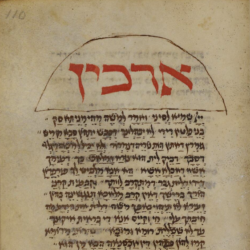
This is “Arkin Hashem Shemaya l’Sinai,” an Aramaic piyyut from late Antiquity by an unknown author. The English translation was made by Dr. Laura Lieber as published in Jewish Aramaic Poetry from Late Antiquity: Translations and Commentaries (Brill: 2018), “10. Moses is Summoned to the Summit (SABM 11),” on pages 40–42. That translation was made against the critical text offered in Shirat Bene Ma’arava: Jewish Palestinian Aramaic from Antiquity [Hebrew], edited and translated by Joseph Yahalom and Michael Sokoloff (Jerusalem: Israel Academy of Sciences and Humanities, 1999). Our transcription was made against the digital text shared from the Comprehensive Aramaic Lexicon, derived from the text published in Shirat Bene Ma’arava.
Notes
| 1 | Find “10. Moses is Summoned to the Summit (SABM 11),” pp. 40–42. |
|---|---|
| 2 | Lit., “The sons of (My) palace.” |
| 3 | Lit., “was Nimrod’s flame.” |
| 4 | I.e., Abraham, as in Bereshit Rabbah 38:11 (361-364). |
| 5 | Deuteronomy 4:24 describes God as a “consuming fire.” In b. Yoma 21b, “the fire that consumes fire” is identified as the Shekhinah. |
| 6 | On the motif of God casting His mantle over Moses to protect him from the angels, see Shemot Rabbah 42:4 (70b) and b. Shabbat 88b. |
| 7 | That is, Moses’ famous “horns”—in the original biblical context, “rays of light” (Exod 34:35)—here serve a defensive purpose. |
| 8 | The motif of an “image” (איקון) of Moses created prior to the world is novel, but it may draw upon the tradition that God created the world for the sake of Moses; see Bereshit Rabbah 1:4 (7). The image of Jacob, however, also mentioned in line 30 below, is an aggadic commonplace; see, e.g., Bereshit Rabbah 12:9 (107). |
| 9 | 26 The final word of this stich (אפרופסין) is difficult. The Comprehensive Aramaic Lexicon (CAL) follows Shirat Bene Ma’arava’s suggestion that it is a Greek loanword (πρόφασις, pretext, excuse), but Sokoloff leaves it untranslated in A Dictionary of Jewish Palestinian Aramaic of the Byzantine Period (2017), p. 48. |
| 10 | A more direct translation yields, “When the angels saw that He was answering them thus,” but the sense is difficult and the text may be slightly corrupt. |
| 11 | The translation follows Shirat Bene Ma’arava in reading דין in place of די on the basis of another manuscript. |
| 12 | This line is translated in keeping with Num 3:12, “Now the man, Moses, was very humble.” This requires a slight emendation of the Aramaic text (ענוונא instead of ענותנותא), which reads “out of humility, he is called Moses.” |
| 13 | The Ḥayyot and Ofanim are two classes of angelic beings. |
| 14 | Exod 20:18, “And Moses drew near into the dark cloud where God was.” |
| 15 | Lit., “stood upright,” perhaps suggesting an imposing visual presence. |
| 16 | The angel functions as a kind of divine herald. |
| 17 | See Exod 34:1 (and Deut 10:1), where in the aftermath of the golden calf episode God commands Moses to write a second set of tablets. |
| 18 | In Ezek 1:26, God’s throne has “the appearance of sapphire.” The poem seems to assume that the original Ten Commandments were carved on stone taken from the heavenly throne. |
| 19 | The translation reflects the variant adopted in ShBM, which is interpreted there as a Greek loanword that refers to a counselor for the defense, a derivative of the verb ἀπολογέομαι. |
| 20 | Greek loanword, from χύριος. |
| 21 | The angels here seem to draw an analogy between themselves and the rock at Massah and Meribah (Exod 17:1-7), noting Moses’ reputation for striking against whatever hinders him; the language harks back to the third stanza, where Moses’ horns are described in terms of self-defense. In Shemot Rabbah 41:7 (6gb–7oa), Moses does in fact attack—with God‘s assistance—the angels of wrath, who seek to prevent him from acquiring the Torah. See Michael Fishbane, The Exegetical Imagination: On Jewish Thought and Theology (Cambridge, MA: Harvard University Press, 1998), 199n16. |
| 22 | Poem 13, line 41, is nearly identical: “The Almighty said to him, “Do not fear, lad? (טליא)!” |
“אַרְכִּין ה׳ שְׁמַיָּא | Arkin Hashem Shemaya, a piyyut narrating the ascent of Mosheh” is shared through the Open Siddur Project under the Creative Commons Attribution-ShareAlike (CC BY-SA) 4.0 International copyleft license.










Leave a Reply