Contributor(s): Shared on: 11 August 2026 under the Creative Commons Zero (CC 0) Universal license a Public Domain dedication Categories: Tags: | Source (Aramaic) | Translation (English) |
|---|
יתגדל ויתקדש וישתבח
שמיה רבא
בעלמא די ברא
כרעותיה |
Magnified and sanctified and praised
be his great name
in the world which he has created
according to his will. |
וימליך מלכותיה
בחייכון וביומיכון
ובחיי דכל בית ישראל
בעגלא ובזמן קריב |
And may he establish his kingdom
during your life and during your days
and during the life of all the house of Israel,
even speedily and at a near time. |
ועונין הצבור אמן
יהא שמיה רבא מברך
לעלם ולעלמי עלמיא |
And the congregation responds, Amen.
Let his great name be blessed
for ever and ever and to all eternity. |
ואומר יתברך
שמיה דקודשא
בריך הוא אמן
ישתבח ויתפאר
ויתרומם ויתהדר
ויתעלה ויתקלס
שמיה דקודשא
בריך הוא אמן
לעילא
מכל ברכתא שירתא
תושבחתא ונחמתא
דאמירן בעלמא
ואמרו אמן |
And he says: Blessed be
the name of the Holy One,
blessed be He (amen).
Praised and glorified
and exalted and honoured
and magnified and lauded
be the name of the Holy One,
blessed be He (amen)
though he be high above
all the blessings and hymns
and praises and consolations
which are uttered in the world.
And say ye: Amen. |
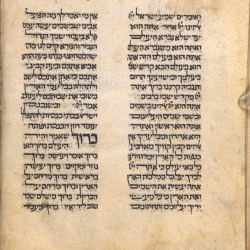
This variation of the Ḥatsi Qaddish can be found in Seder Rav Amram (Bodleian Library, shelfmark: Ms. Opp. Add. Qu. 28; catalogue: Neubauer, Oxford, England 1095). The manuscript images are not yet digitized and/or publicly accessible. David Hedegard transcribed three manuscript versions of the Ḥatsi Qaddish in his dissertation on Seder R. Amram Gaon (Lindstedt, 1951). In his transcription, this source is labeled [א] and in his translation, [O]. I have modifited Hedegard’s translation slightly by re-Hebraizing divine names. Source(s) “חֲצִי קַדִּישׁ | Ḥatsi Qaddish, from the Seder Rav Amram attested in Bodleian Library Ms. Opp. Add. Qu. 28” is shared through the Open Siddur Project under the Creative Commons Zero (CC 0) Universal license a Public Domain dedication.
Aharon Varady (M.A.J.Ed./JTSA Davidson) is a volunteer transcriber for the Open Siddur Project. If you find any mistakes in his transcriptions, please let him know. Shgiyot mi yavin; Ministarot naqeni שְׁגִיאוֹת מִי־יָבִין; מִנִּסְתָּרוֹת נַקֵּנִי "Who can know all one's flaws? From hidden errors, correct me" (Psalms 19:13). If you'd like to directly support his work, please consider donating via his Patreon account. (Varady also translates prayers and contributes his own original work besides serving as the primary shammes of the Open Siddur Project and its website, opensiddur.org.)  Oskar David Leonard Hedegård (1891-1971), born in Östergötland, Sweden was a Swedish theologian and Bible translator. He was first active in the Swedish Missionary Union where he became a member in 1909. He was a preacher in the Spelvik -Husby mission district in 1911–1912 and then in the Mariefred mission congregation in 1913–1915. He attended the Missionary Union's theological seminary on Lidingö in 1915–1917 and in 1917 became a preacher in the Jönköping Ansgariiförening. After graduating as a private student in 1920, he moved to Lund and was pastor of the Bethel missionary congregation in Eslöv from 1923 to 1925. He simultaneously pursued university studies and became a candidate of philosophy in 1924 and a candidate of theology in 1928. Hedegård was a teacher at the Theological Seminary in Lidingö from 1928 to 1940. In 1930 he published the book The Old Testament Sacrifice Service in which he emerged as a conservative biblical theologian; the book was a kind of response to the book Priests and Prophets in the Development of Biblical Religions by the SMF's mission director Axel Andersson, which had been published the previous year. Hedegård was the initiator of the Association for Biblical Faith in 1937 and from then until his death published its magazine For Biblical Faith. Together with the Finnish professor Aapeli Saarisalo, he published Biblical Encyclopedia. Handbook for Bible Readers (1939), which has been published in five revised editions. Due to differences of opinion regarding the Bible, Hedegård left the Swedish Missionary Union in 1940. He became rector of the Alliance Mission seminary in Kortebo near Jönköping in 1941 and became a licentiate in theology in 1943. In 1951 at the age of 60, inspired by his teacher Professor Hugo Odeberg, he defended his doctoral thesis on a Jewish liturgical handbook from the 8th century, Seder R. Amaram Gaon. He was also one of the initiators of the Nordic Evangelical Council, of which he was chairman throughout its entire period of operation, 1955–1968. Sometimes the best we can do in attributing a historical work is to indicate the period and place it was written, the first prayer book it may have been printed in, or the archival collection in which the manuscript was found. We invite the public to help to attribute all works to their original composers. If you know something not mentioned in the commentary offered, please leave a comment or contact us. Read a comment / Leave a comment (moderated) Works of related interest: |
![the Open Siddur Project [logo]](https://opensiddur.org/wp-content/uploads/2018/09/Open-Siddur-Project-Logo-2016.svg)







Leave a Reply