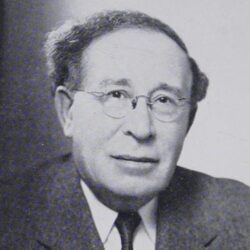
Israel Bettan (1889–1957), born in Shaty, Kovno Governorate, Russian Empire, was a Reform movement rabbi, teacher, and leader in the United States. He immigrated to America in 1904 after having studied at the Slabodka Yeshiva. By 1907 he was studying at the Isaac Elchanan Yeshivah in New York. He then went to the University of Cincinnati, where he graduated with a B.A. in 1910, and Hebrew Union College, where he was ordained a rabbi in 1912 and received a D.D. in 1915. His dissertation, published in 1914, was Opposition of Orthodoxy to early Reform: A study of the leading opponents of Reform prior to Geiger. Rabbi Bettan then served Congregation B'nai Israel in Charleston, West Virginia, from 1912 to 1922. While in Charleston, he became chairman of the City Survey Commission (1915-1917), president of the Charleston Federated Charities (1916-1918), and a member of the Child Welfare Committee of West Virginia (1921-1923). Following World War Ⅰ (1918-1919), he served as a chaplain in the American Expeditionary Forces. In 1922, he became professor of homiletics and Midrash at Hebrew Union College where he eventually taught for 35 years. Rabbi Bettan wrote Studies in Jewish Preaching (1939) and The Five Scrolls: A Commentary (1950) among other articles, tracts, and monographs. He was twice a member of the committee that revised the Union Prayer Book. He was named president of the Central Conference of American Rabbis in 1956.
Filter resources by Category
Filter resources by Tag
Filter resources by Name
Filter resources by Language
Filter resources by Date Range
Contributed by:
Solomon B. Freehof, Israel Bettan, Abraham Cronbach, Morris Samuel Lazaron, Abram Simon, Central Conference of American Rabbis [CCAR]
ברכה ותהלה Blessing and Praise: A Book of Meditations and Prayers for Individual and Home Devotion (CCAR 1923) is a collection of fifty teḥinot and devotional readings in vernacular English. The work was compiled by a committee chaired by Rabbi Solomon Freehof, along with Rabbi Israel Bettan, Rabbi Abraham Cronbach, Rabbi Morris S. Lazaron, and Rabbi Abram Simon.
![the Open Siddur Project [logo]](https://opensiddur.org/wp-content/uploads/2018/09/Open-Siddur-Project-Logo-2016.svg)


