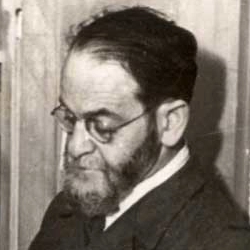
 Rabbi Maurice Liber (1884–1956), born in Warsaw, he was a scholar and the chief rabbi of France. Liber came to Paris with his parents at the age of four. After graduating from the Ecole Rabbinique de Paris in 1907 he began lecturing on Jewish history there. In 1911 he was appointed assistant to the chief rabbi of Paris, serving as an army chaplain and receiving the Croix de Guerre during World War Ⅰ. In 1920 Liber became rabbi at the Rue de la Victoire synagogue, in 1921 lecturer in the history of rabbinic Judaism at the Ecole Pratique des Hautes Etudes, and in 1927 succeeded his teacher Israël Lévi as professor. He was appointed director of religious education by the Paris Consistoire in 1930 and, two years later, head of the Ecole Rabbinique. In 1934 Liber was appointed chief rabbi of France par interim, to assist the aging Israël Lévi in his task. Under the German occupation of France during World War Ⅱ, he strove hard to safeguard the Ecole Rabbinique – which had been evacuated to unoccupied southern France – and the religious character of the Consistoire. He also strove to maintain some sort of Jewish education, both legal and underground. Liber's chief field of research was French-Jewish history. He is best known by his biography of Rashi (1905; Eng. tr. 1906). He wrote a series of articles, based on archival sources, under the title "Les Juifs et la convocation des Etats Généraux" (in REJ, vols. 63–66, 1912–13), and another series, "Napoléon et les Juifs" (ibid., vols. 71–72, 1920–21). On liturgy he wrote, among other works, La Récitation du Schema… (1909), "La Formation de la liturgie Synagogale" (in Annuaire de l'Ecole des Hautes Etudes, 1933/34), and "Structure and History of the Tefilah" (in JQR, 40 (1949/50), 331–57). Liber also wrote an extensive introduction to the reprint of M. Schwab's French translation of the Palestinian Talmud (1932). Liber opposed Zionism, calling it a national theory unacceptable to those who believe that emancipation resolved the national question for the Jews. Though deeply religious, he felt compelled to compromise with the facts of French synagogue life, such as the use of an organ. Filter resources by Category Filter resources by Tag Filter resources by Name Filter resources by Language Filter resources by Date Range
Contributed by:
Aharon N. Varady (digital imaging and document preparation), Maurice Liber, Mayer Lambert, Isaïe Schwartz, Consistoire central israélite de France La Tefila du Soldat is an abridged bilingual Hebrew-French prayerbook for French-Jewish soldiers prepared in 1939 by Rabbi Maurice Liber, the former interim Chief Rabbi of France under Rabbi Israël Lévi (from 1934-1939). In addition to abridged liturgy, the prayerbook also contains a curated selection of teḥinot in vernacular French, and psalms in French translation. Rabbi Isaie Schwartz, appointed chief rabbi in 1939, wrote the introductory letter to Jewish soldiers at the start of the French section of the siddur. In it, he notes the prayerbook is, essential, a copy of one offered to French-Jewish soldiers by the Consistoire central israelíte de France during World War Ⅰ.
|
![the Open Siddur Project [logo]](https://opensiddur.org/wp-content/uploads/2018/09/Open-Siddur-Project-Logo-2016.svg)


