⤷ You are here:   👂︎ Liturgical Readings, Sources, and Cantillation   —⟶   Meḳorot (Sources)   —⟶   📜 TaNaKh (Torah, Nevi'im, Ketuvim)   —⟶   Targumim (Translations)   —⟶   ספר חמשה חמשי תורה וסדר הפטרות השנה | A Lei de Moisés e as Haftarot — compiled with Portuguese translation and commentary by…

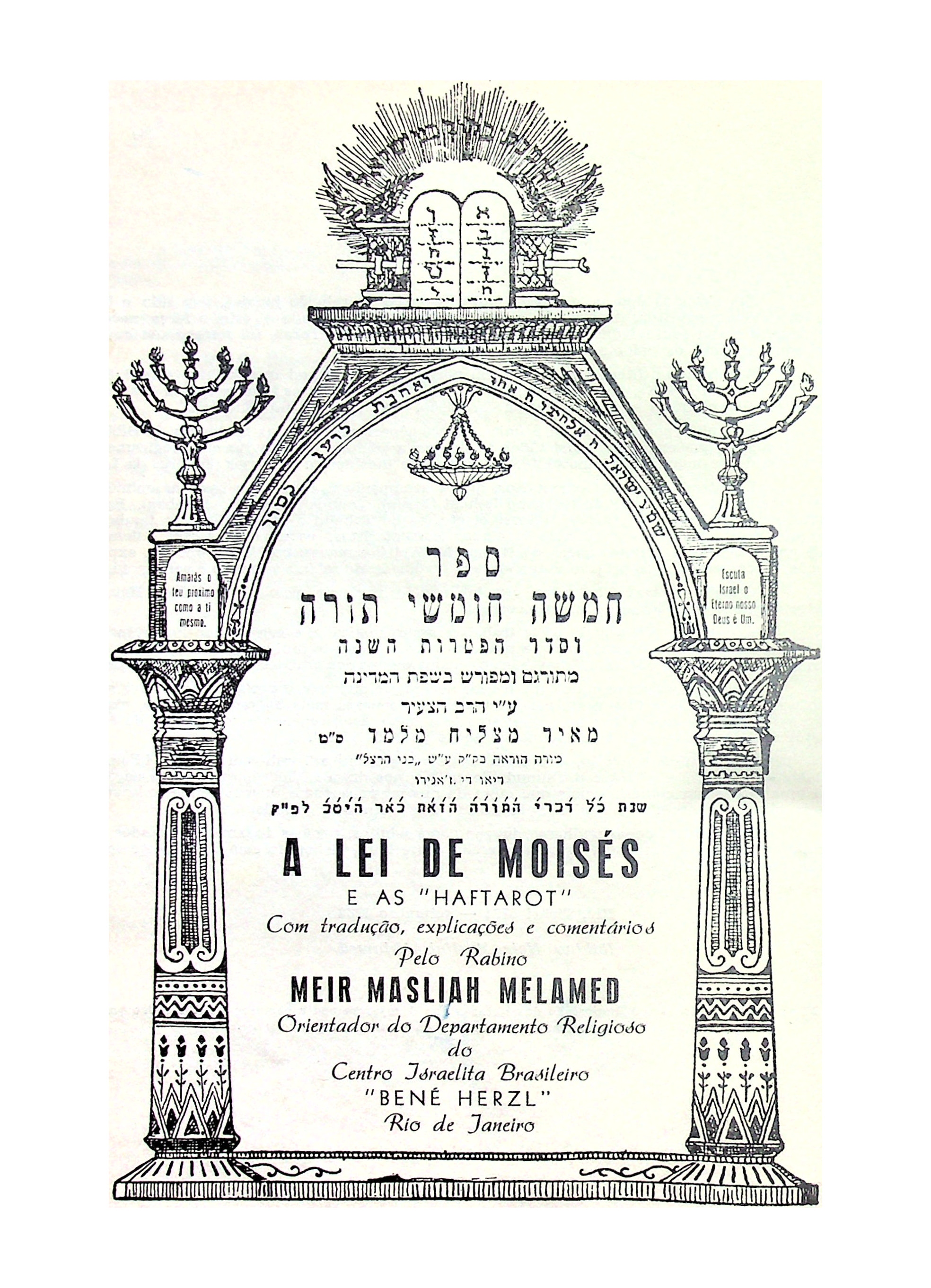
🆕 ספר חמשה חמשי תורה וסדר הפטרות השנה | A Lei de Moisés e as Haftarot — compiled with Portuguese translation and commentary by Rabbi Meïr Matsliaḥ Melamed (1962)

A ḥumash in Hebrew with a translation and commentary in Portuguese by Rabbi Meïr Matsliaḥ Melamed.

Loading
Enter fullscreen Exit fullscreen


Source (Portuguese)Translation (English)
Prefácio do Autor
Author’s Preface
Em tôdas as épocas, a Torah, fonte essencial da religião judaica, tem sido a base da unidade espiritual de Israel, e esta unidade é que tem dado a êste, a fôrça necessária para a sua sobrevivência. Por conseguinte, o estudo da Torah, foi sempre um dever primordial para os adeptos da nossa religião.
Throughout the ages, the Torah—the essential source of the Jewish religion—has been the foundation of Israel’s spiritual unity, and it is this unity that has given Israel the strength necessary for its survival. Consequently, the study of the Torah has always been a primary duty for the followers of our religion.
Analisando a literatura judaica em português, verifiquei que faltava a tradução da «LEI DE MOISÉS», nêste idioma, isto é, uma tradução fiel às interpretações dos nossos exegetas, os quais se inspiraram na Tradição, no Talmud e no Midrash.
Upon reviewing Jewish literature in Portuguese, I found that a translation of the “LAW OF MOSES” was lacking in this language—that is, a translation faithful to the interpretations of our exegetes, who drew inspiration from the Tradition, the Talmud, and the Midrash.
Esta obra, posso afirmá-lo, é única em seu gênero, pois que, as traduções da Bíblia, em portugués, que examinei, quasi tôdas se limitam a traduzir as palavras etimológicamente, deixando de lado o mais importante: o sentido que lhes deram os nossos doutores da Lei.
I can affirm that this work is unique in its genre, since the Portuguese translations of the Bible that I examined are almost all limited to translating the words etymologically, leaving aside what is most important: the meaning given to them by our doctors of the Law.
Esta tradução e os comentários, que a acompanham, têm como base as opiniões dos exegetas, tais como: Rabi Shelomó Is-haki (Rashi), Onklos (Targum), Rishbam, Baal Haturim, Daat Zekenim Mibaalé Hatossafot etc., as do Talmud e as do Midrash; também foram consultadas obras modernas de alguns comentaristas, escritas em vários idiomas tais como «Varietés Homilétiques» do Rabino M. Wolff, e outras; por fim, a opinião, explicações e comentários do próprio autor, em sua qualidade de rabino ortodoxo e conservador.
This translation and the accompanying commentaries are based on the opinions of exegetes such as Rabbi Shlomo Ishaki (Rashi), Onkelos (Targum), Rishbam, Baal Haturim, Da’at Zekenim Miba’alei Ha-Tossafot, etc., as well as those found in the Talmud and the Midrash; modern works by certain commentators, written in various languages—such as Rabbi M. Wolff’s *Variétés Homilétiques* and others—were also consulted; finally, the author’s own opinions, explanations, and commentaries, in his capacity as an Orthodox and Conservative rabbi.
Quanto ao texto hebraico, escolhi aquêle revisado pelo erudito Meir Halevi Leteris, que é considerado dos mais corretos.
As for the Hebrew text, I chose the one revised by the scholar Meir Halevi Leteris, which is considered one of the most accurate.
A extrema dificuldade déste trabalho, assim realizado, e sua grande importância, não passarão desapercebidos aos que possuem o conhecimento profundo do texto original. Em suma, esta é uma obra de fé, baseada nos ensinamentos dos grandes mestres do judaísmo.
The extreme difficulty of this work, as it has been carried out, and its great importance will not go unnoticed by those who possess a deep understanding of the original text. In short, this is a work of faith, based on the teachings of the great masters of Judaism.
Hoje, mais do que nunca, me parece necessário divulgar, especialmente à nova geração que só utiliza o idioma do país, o conteúdo da nossa mais Sagrada Escritura, para que saiba alguma coisa do que o judaísmo tem dado espiritualmente ao mundo, da sua história, e da sua missão, como descendente do povo de Israel.
Today, more than ever, it seems necessary to me to share—especially with the younger generation, who speak only the language of this country—the content of our most sacred Scripture, so that they may learn something of what Judaism has contributed spiritually to the world, of its history, and of its mission as descendants of the people of Israel.
Conforme a Tradição, o profeta Moisés explicou a Torah em setenta idiomas (Rashi – Deut. 1:5 e Deut. 27:8); e o Talmud (Sotah 35) nos diz a razão: «para que as nações do mundo possam copiá-la», pois que além de nós mesmos, todos devem conhecer a verdade sôbre o conteúdo da «LEI DE MOISÉS» e a sua moral elevada.
According to Tradition, the prophet Moses explained the Torah in seventy languages (Rashi – Deut. 1:5 and Deut. 27:8); and the Talmud (Sotah 35) tells us the reason: “so that the nations of the world may copy it,” for besides ourselves, everyone should know the truth about the content of the “LAW OF MOSES” and its lofty morality.
Se, homens como mulheres, jovens como adultos, pessoas imparciais de todos os credos e amigos da verdade, tirarem proveito dêste livro, elaborado com boa fé, isto será minha recompensa.
If men and women alike, young and old, impartial people of all faiths, and friends of the truth benefit from this book, written in good faith, that will be my reward.
Rio, Tishri 5723 — setembro 1962
Rabino Meir Masliah Melamed
Rio, Tishri 5723 — September 1962
Rabbi Meir Masliah Melamed
Source (Portuguese)Translation (English)
INTRODUÇÃO
INTRODUCTION
Chama-se «Lei de Moisés» ou «Pentatêuco», (em hebraico Humash, Hamishá Humshé Torah ou simplesmente, Torah), ao conjunto dos cinco primeiros livros da Bíblia, que são: Gênesis. Exodo, Levítico, Números e Deuteronômio, (em hebraico: Bereshit, Shemót, Vayikrah, Bamidbar e Devarim).
The term “Law of Moses” or “Pentateuch” (in Hebrew: Humash, Hamishá, Humshé Torah, or simply Torah) refers to the first five books of the Bible, which are: Genesis. Exodus, Leviticus, Numbers, and Deuteronomy (in Hebrew: Bereshit, Shemot, Vayikra, Bamidbar, and Devarim).
Os nomes que derivam do grego estão relacionados com o conteúdo, enquanto que as denominacôes‎ hebraicas são constituídas pela primeira ou principal palavra do início de cada livro.
The names derived from Greek are related to the content, while the Hebrew titles consist of the first or main word at the beginning of each book.
A autoria do Pentateuco é atribuida a Moisés, que o escreveu sob inspiração divina. À crença afirma que a Torah que possuimos hoje é a mesma que nos transmitiu Moisés. Esta afirmação taz parte dos Treze Artigos de Fé Judaica de Maimônides (Shelosh-esré ikarim le «Harambam»).
The authorship of the Pentateuch is attributed to Moses, who wrote it under divine inspiration. The belief holds that the Torah we possess today is the same one that Moses transmitted to us. This assertion is part of Maimonides’ Thirteen Principles of Jewish Faith (Shelosh-esré ikarim le “Harambam”).
Existem três diferentes redações do Pentatêuco: a judaica, a samaritana e a grega da «Versão dos Setenta» e a versão latina desta, denominada «Vulgata». A mais próxima à judaica é a grega.
There are three different versions of the Pentateuch: the Jewish version, the Samaritan version, and the Greek version known as the “Septuagint,” as well as the Latin version of the Septuagint, called the “Vulgate.” The Greek version is the closest to the Jewish version.
A redação judaica foi vocalizada pelos rabinos massoraitas, aproximadamente no século Ⅶ depois da éra comum.
The Jewish version was vocalized by the Masoretic rabbis, approximately in the 7th century CE.
A redação samaritana, a mais recente das três, difere bastante da judaica e da versão grega.
The Samaritan version, the most recent of the three, differs significantly from both the Jewish and Greek versions.
O Pentateuco contém a história do Homem, a origem do povo hebreu e tôda sua legislação civil e religiosa, finalizando com a morte de Moisés.
The Pentateuch contains the history of humankind, the origin of the Hebrew people, and their civil and religious laws, concluding with the death of Moses.
No que concerna à autoria dos oito versículos finais na Torah, que tratam da morte e sepultamento de Moisés (Deut. 34, 5), o «Talmud» (B. B. 14b) a‎ atribui a Josué, seu sucessor, o qual acompanhou o seu mestre até os últimos momentos.
Regarding the authorship of the final eight verses of the Torah, which deal with the death and burial of Moses (Deut. 34:5), the “Talmud” (B.B. 14b) attributes them to Joshua, his successor, who accompanied his master until his final moments.
A Torah contém cinco mil oitocentos e quarenta e cinco versículos.
The Torah contains 5,845 verses.


Read a comment / Leave a comment (moderated)

Leave a Reply

You can use these HTML tags

<a href="" title=""> <abbr title=""> <acronym title=""> <b> <blockquote cite=""> <cite> <code> <del datetime=""> <em> <i> <q cite=""> <s> <strike> <strong>


Works of related interest: 
prev next


the Open Siddur Project  //  Main Menu


Categories Index: