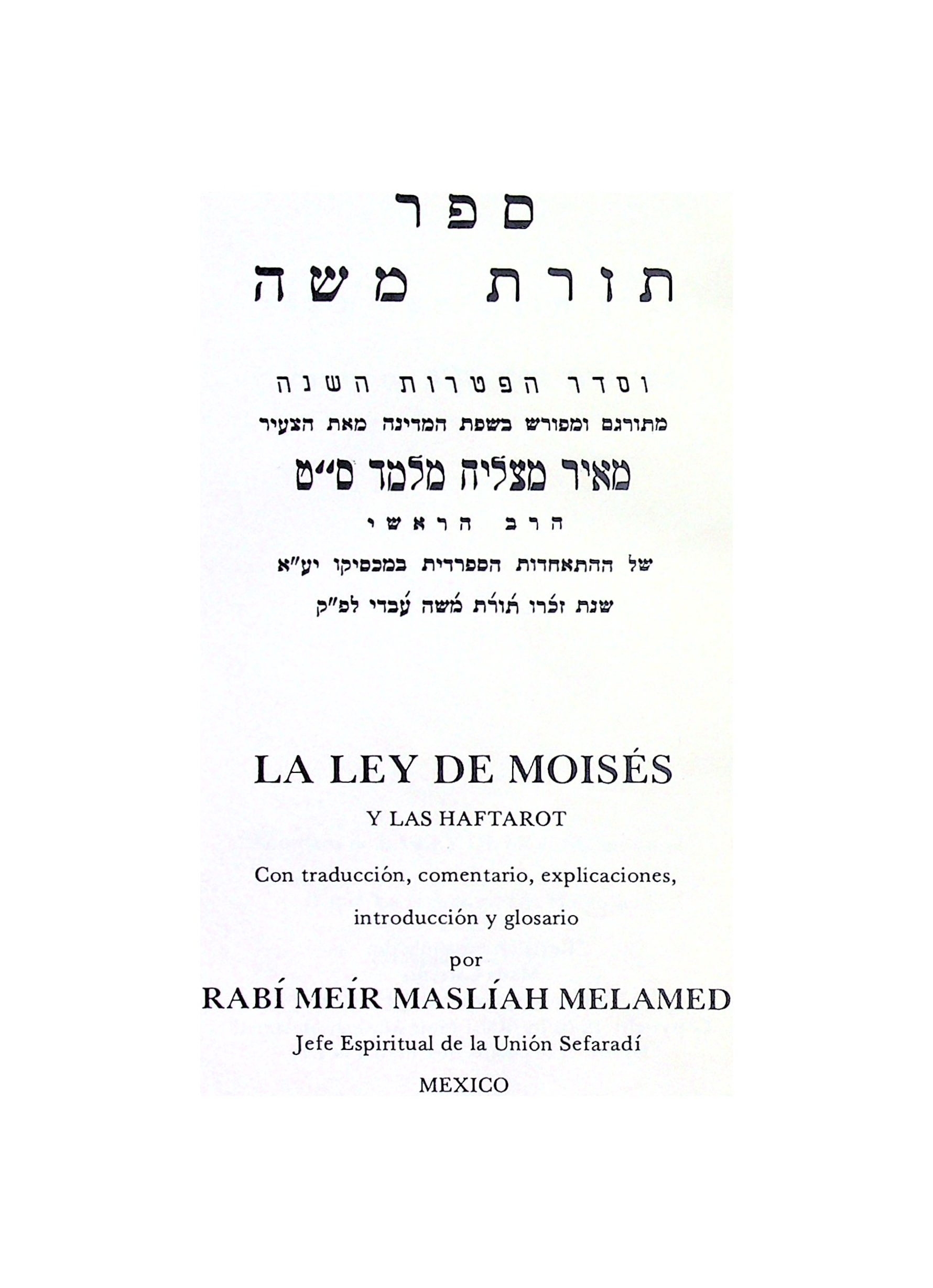
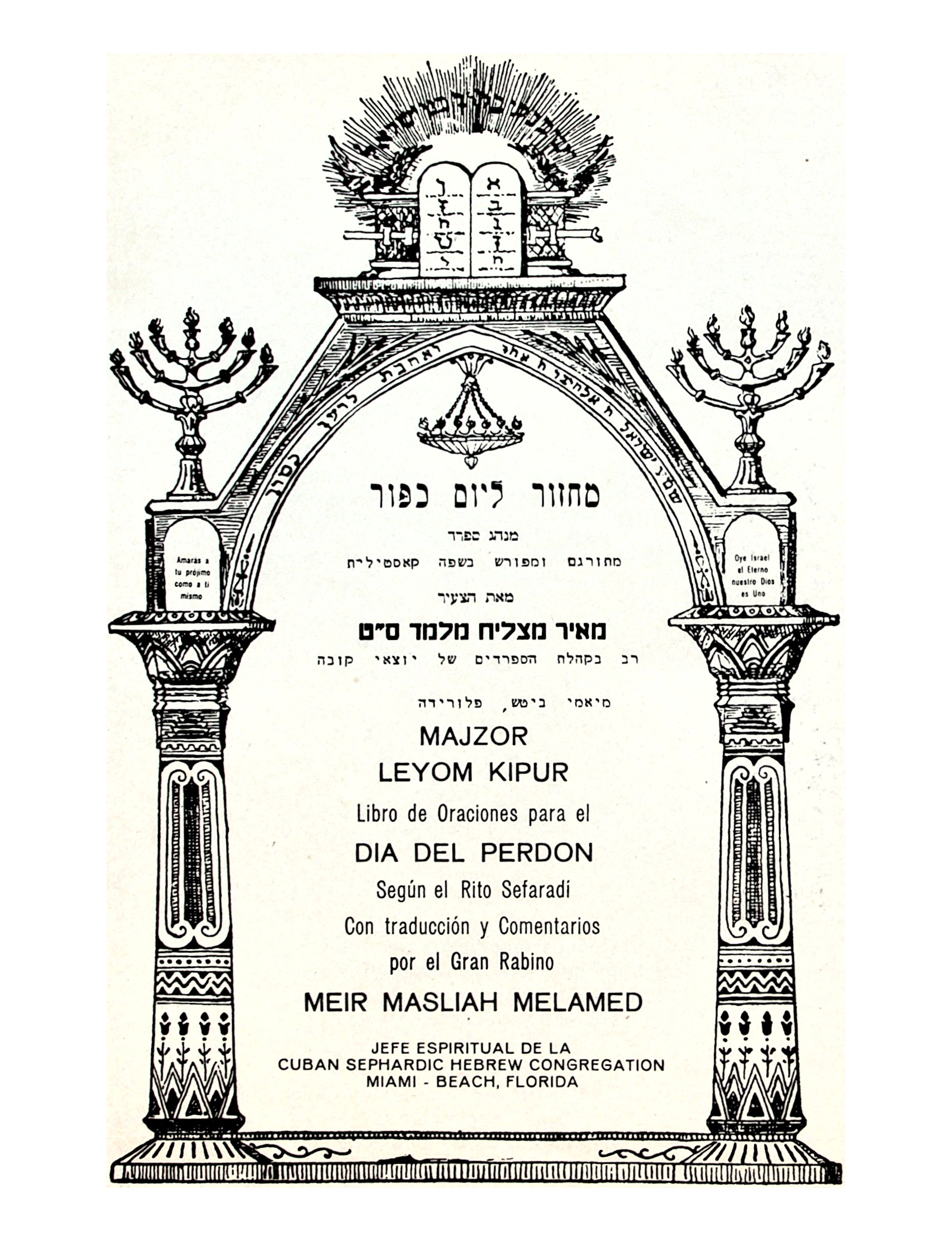
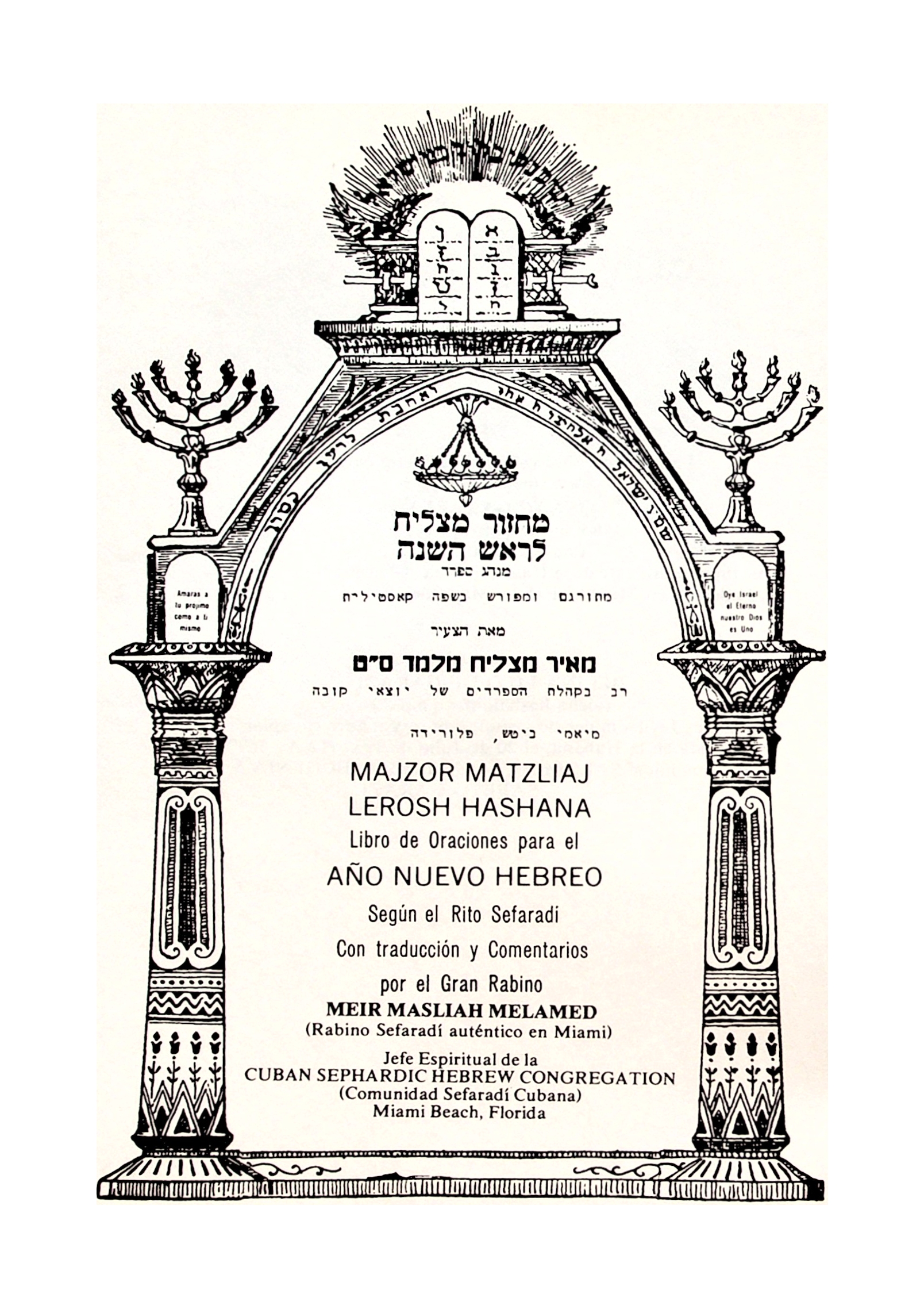
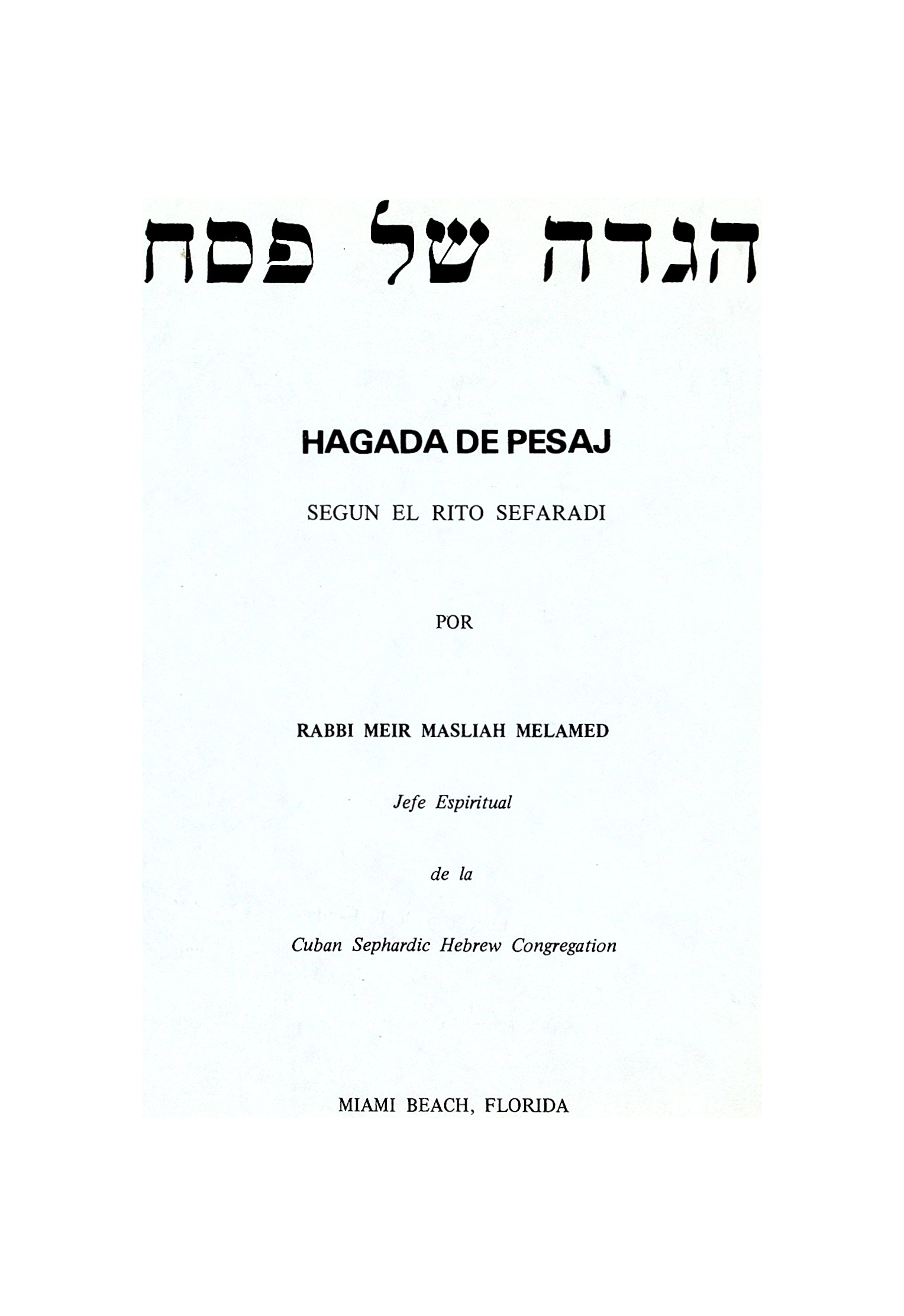
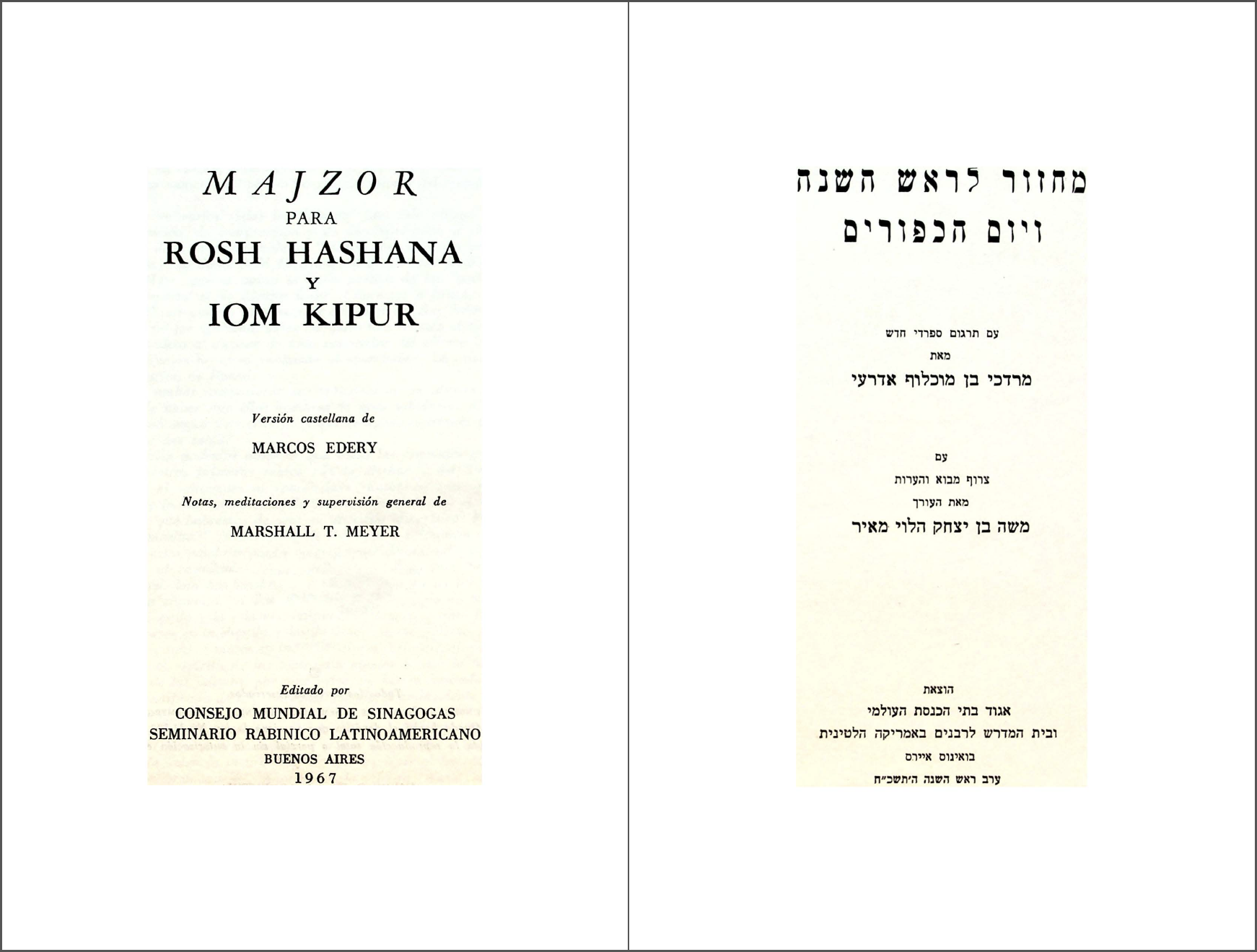
This is the first volume (Genesis) of a bilingual Hebrew-Spanish ḥumash in Hebrew compiled by Rabbi Meïr Matsliaḥ Melamed with his translation and commentary. Haftarot for each parashah are included at the end of the volume.


This work is in the Public Domain according to the 1994 Uruguay Round Agreements Act due to the expiration of the term of copyright in its home country (50 years after publication in Mexico).
Source (Spanish) Translation (English) PREFACIO PREFACE En todas las épocas, la Torah, fuente esencial de la religión judaica, ha sido la base de la unidad espiritual de Israel, y esta unidad es la que le ha dado la fuerza necesaria para la supervivencia. La luz de la Torah ha iluminado la vida judía a través de los siglos, dándole el contenido y significado espirituales que constituyen la razón última de la existencia del pueblo de Israel. Es en la Torah, en la Ley de Moisés, donde el israelita ha encontrado la eterna inspiración que le permitió resistir a las terribles vicisitudes que marcaron su destino. El código de Moisés, la palabra candente de los profetas, son las contribuciones decisivas del pueblo judío a la civilización universal. Los ideales del perfeccionamiento moral, de la justicia social, y sobre todo la preocupación por la búsqueda de la felicidad humana, son los puntos capitales de la doctrina de Moisés y de sus seguidores, los profetas. Throughout the ages, the Torah — the essential source of the Jewish religion — has been the foundation of Israel’s spiritual unity, and it is this unity that has given it the strength necessary for survival. The light of the Torah has illuminated Jewish life throughout the centuries, giving it the spiritual substance and meaning that constitute the ultimate reason for the existence of the people of Israel. It is in the Torah, in the Law of Moses, that the Israelites have found the eternal inspiration that enabled them to withstand the terrible trials that have marked their destiny. The code of Moses and the fiery words of the prophets are the Jewish people’s decisive contributions to universal civilization. The ideals of moral perfection, social justice, and above all, the pursuit of human happiness, are the cornerstones of the doctrine of Moses and his followers, the prophets. En esta época conturbada en que vive nuestra civilización, en que los pueblos desorientados se agitan ansiando una vida mejor y más justa, no podemos olvidar las enseñanzas que emanan de la Torah al indicarnos el camino de la verdad. Este es el legado imperecedero del pueblo judío a la humanidad; a una humanidad que incorporó para sí la palabra de Dios, que adoptó las reglas éticas del decálogo en diversas formas, pero que ha negado un poco de paz y justicia a este pueblo que registró el verbo divino, y que a través de siglos de inenarrables sufrimientos mantuvo este legado a costa de su sangre. In these turbulent times our civilization is facing, when disoriented peoples are in turmoil, yearning for a better and more just life, we cannot forget the teachings that flow from the Torah as it shows us the path to truth. This is the enduring legacy of the Jewish people to humanity — to a humanity that has embraced the word of God, that has adopted the ethical precepts of the Ten Commandments in various forms, but that has denied even a modicum of peace and justice to this people who recorded the divine word and who, through centuries of unspeakable suffering, preserved this legacy at the cost of their own blood. Facilitar pues el acceso a la Ley de Moisés, particularmente a las nuevas generaciones, es deber de los grandes maestros y hombres sabios. It is therefore the duty of great teachers and wise men to facilitate access to the Law of Moses, particularly for the younger generations. Hasta que llegue el auspicioso día en que la lengua hebrea se torne patrimonio espiritual común a todo israelita, las traducciones de la Biblia, completas o en parte como ésta, serán absolutamente necesarias. Ellas son el vínculo indispensable para nuestra integración como pueblo impregnado en la misma cultura. Until the auspicious day arrives when the Hebrew language becomes the common spiritual heritage of all Israelites, translations of the Bible — whether complete or partial, like this one —w ill be absolutely necessary. They are the indispensable link for our unity as a people steeped in the same culture. En los tiempos clásicos de nuestra unidad nacional, especialmente en la época del primer Templo, cuando Israel constituía un solo pueblo con una misma lengua, viviendo compacto dentro de las fronteras del Estado, nadie pensaría en tal necesidad. Mas las primeras diásporas de nuestro pueblo y la de Babilonia en particular, así como la de los países adyacentes del Mediterráneo, bajo la influencia helénica, vinieron a quebrar nuestra unidad lingúística. In the classical era of our national unity — especially during the time of the First Temple, when Israel was a single people with a common language, living together within the borders of the state — no one would have thought such a need existed. But the first diasporas of our people — particularly that of Babylon, as well as those in the neighboring Mediterranean countries under Hellenistic influence — ended up shattering our linguistic unity. No fue pues por acaso que la más antigua e ilustre de las traducciones bíblicas, la Septuaginta en griego, tuvo su raíz en Egipto durante el reinado de Ptolomeo Filadelfo, casi tres siglos antes de la E.C. Ni fue mera coincidencia el hecho de que cuatro siglos más tarde la segunda traducción bíblica, la de Onklós, fuera redactada en idioma arameo, lengua que nuestro pueblo hablaba en la época de la destrucción del segundo Templo. Bastan estos dos ejemplos, los más antiguos, para comprobar que por muchos años todavía no podremos prescindir de buenas y fieles traducciones de la Biblia, árbol de vida para toda la humanidad. It was therefore no coincidence that the oldest and most illustrious of the biblical translations, the Greek Septuagint, had its origins in Egypt during the reign of Ptolemy Philadelphus, nearly three centuries before the Common Era. Nor was it a mere coincidence that four centuries later, the second biblical translation — that of Onkelos — was written in Aramaic, the language our people spoke at the time of the destruction of the Second Temple. These two examples — the oldest ones — are sufficient to show that for many years to come, we will still be unable to do without good and faithful translations of the Bible, the tree of life for all humanity. Analizando la literatura judaica en español, verifiqué que faltaba la traducción de la Ley de Moisés en este idioma, esto es, una traducción fiel a las interpretaciones de nuestros exegetas, los cuales se inspiraron en la tradición, en el Talmud y en el Midrash. In analyzing Jewish literature in Spanish, I found that there was no translation of the Law of Moses into this language — that is, a translation faithful to the interpretations of our exegetes, who drew inspiration from tradition, the Talmud, and the Midrash. Lo cierto es que de las traducciones que examiné, casi todas tropiezan con las dificultades inherentes a la naturaleza de este famoso libro. Escrito en una época muy antigua, presenta arcaísmos en sus textos, a veces tan oscuros que han dado margen a interpretaciones erróneas, y más de una vez provocaron serias controversias. El idioma hebreo, como todas las lenguas, sufrió en el transcurso de los siglos modificaciones semánticas, de tal forma que al traducir ciertos pasajes al idioma hebreo actual, resultarían incoherentes con relación al significado de la época en que se redactó definitivamente el libro. The truth is that of the translations I examined, almost all encounter difficulties inherent in the nature of this famous book. Written in very ancient times, it contains archaic expressions in its texts, sometimes so obscure that they have given rise to erroneous interpretations and, on more than one occasion, sparked serious controversies. The Hebrew language, like all languages, has undergone semantic changes over the centuries, such that when certain passages are translated into modern Hebrew, they may seem inconsistent with the meaning intended at the time the book was finally written. Esta obra, puedo afirmarlo, es única en su género, puesto que las traducciones de la Biblia en castellano que examiné se limitan casi todas a trasladar las palabras etimológicamente, dejando de lado lo más importante: el sentido que les dieron nuestros doctores en la Ley. I can affirm that this work is unique in its genre, since the Spanish translations of the Bible that I examined are almost all limited to rendering the words etymologically, leaving aside what is most important: the meaning that our doctors of the Law ascribed to them. Esta traducción y los comentarios que la acompañan tienen como base las opiniones de los exegetas, tales como Rabí Shelomó Yitzjakí (Rashí), Onklós (Targum), Rishbam, Baal Haturim, Daat Zekenim Mibaalé Hatosafot, etc. y las del Talmud y el Midrash. También fueron consultadas obras modernas de algunos comentaristas, escritas en varios idiomas, figurando finalmente la opinión, explicaciones y comentarios del propio autor, en su calidad de rabino conservador. This translation and the accompanying commentary are based on the opinions of exegetes such as Rabbi Shlomo Yitsḥaqi (Rashi), Onkelos (Targum), Rishbam, Baal Haturim, Da’at Zekenim Miba’alei Ha-Tosafot, etc., as well as those found in the Talmud and the Midrash. Modern works by various commentators, written in several languages, were also consulted, and the author’s own opinions, explanations, and comments — in his capacity as a conservative rabbi — are included at the end. En cuanto al texto hebraico, escogí aquél revisado por el erudito Meír Haleví Letteris, que está considerado entre los más correctos. As for the Hebrew text, I chose the one revised by the scholar Meir Halevi Letteris, which is considered one of the most accurate. La extrema dificultad de un trabajo realizado de este modo y su gran importancia, no pasarán desapercibidas a los que poseen el conocimiento profundo del texto original. En suma, es ésta una obra de fe, basada en las enseñanzas de los grandes maestros del judaísmo. The extreme difficulty of a work undertaken in this manner and its great importance will not go unnoticed by those who possess a deep understanding of the original text. In short, this is a work of faith, based on the teachings of the great masters of Judaism. Hoy más que nunca me parece necesario divulgar, especialmente para la nueva generación que sólo utiliza el idioma del país, el contenido de nuestra máxima Escritura Sagrada, para que sepa en su calidad de descendiente de Israel, lo que el judaísmo tiene dado espiritualmente al mundo. Today more than ever, I believe it is necessary to share — especially with the younger generation, who speak only the language of this country — the content of our holiest Scripture, so that they may know, as descendants of Israel, what Judaism has contributed spiritually to the world. Según la tradición, el profeta Moisés explicó la Torah en setenta idiomas (Rashí, Deut. 1, 5 y Deut. 27, 8); y el Talmud (Sotah 35) nos dice la razón: “para que las naciones del mundo puedan copiarla”, puesto que además de nosotros, todos deben conocer la verdad sobre el contenido de la Ley de Moisés y su moral elevada. According to tradition, the prophet Moses explained the Torah in seventy languages (Rashi, Deut. 1:5 and Deut. 27:8); and the Talmud (Sotah 35) tells us the reason: “so that the nations of the world may copy it,” since, in addition to us, everyone should know the truth about the content of the Law of Moses and its high moral standards. Para facilitar la lectura de esta obra he agregado, al final del libro quinto, Deuteronomio (Devarim), un glosario de las voces hebreas empleadas. To make this work easier to read, I have included a glossary of the Hebrew terms used at the end of the fifth book, Deuteronomy (Devarim). Deseo agradecer a mi esposa Nelly Levy de Masliah su valiosa ayuda, al Prof. Saúl Lokier su colaboración técnica, y a la UNION SEFARADÍ el apoyo que siempre me dispensó desde que ocupo el cargo en esta prestigiosa Congregación. I would like to thank my wife, Nelly Levy de Masliah, for her invaluable help; Prof. Saúl Lokier for his technical assistance; and the UNION SEFARADÍ for the support it has always provided me since I assumed my position in this prestigious congregation. Si tanto hombres como mujeres, jóvenes como adultos, personas imparciales de todos los credos y amigos de la verdad, sacan provecho de este libro elaborado con buena fe, ésta será mi recompensa. If men and women alike, young people and adults, impartial people of all faiths, and friends of the truth all benefit from this book, which was written in good faith, that will be my reward. RABÍ MEÍR MASLIAH MELAMED Rabbi Meir Matsliaḥ Melamed
Source (Spanish) Translation (English) LA LEY DE MOISÉS: INTRODUCCION THE LAW OF MOSES: INTRODUCTION Se llama Ley de Moisés o Pentateuco (en hebreo Jumash, Jamishá Jumshé Torah, o simplemente Torah) al conjunto de los primeros cinco libros de la Biblia, que son: Génesis, Éxodo, Levítico, Números y Deuteronomio, (en hebreo Bereshit, Shemot, Vayikrah, Bamidbar y Devarim). The Law of Moses, also known as the Pentateuch (in Hebrew, Chumash, Chumishah Chumshé Torah, or simply Torah), refers to the first five books of the Bible: Genesis, Exodus, Leviticus, Numbers, and Deuteronomy (in Hebrew, Bereshit, Shemot, Vayikrah, Bamidbar, and Devarim). Los nombres que derivan del griego están relacionados con el contenido de cada libro; en cuanto a las denominaciones hebreas, están constituídas por la primera o principal palabra que inicia cada libro. The names derived from Greek are related to the content of each book; as for the Hebrew names, they consist of the first or main word that begins each book. La autoría del Pentateuco se atribuye a Moisés, que lo escribió bajo la inspiración divina. La creencia afirma que la Torah que poseemos hoy es la misma que nos transmitió Moisés. Esta afirmación hace parte de los Trece Artículos de la Fe Judaica de Maimónides (¡Sheloshá-asar ikarím le Harambam). The authorship of the Pentateuch is attributed to Moses, who wrote it under divine inspiration. The belief holds that the Torah we possess today is the same one that Moses transmitted to us. This assertion is part of Maimonides’ Thirteen Principles of Jewish Faith (Sheloshá-asar ikarím le Harambam). Existen cuatro diferentes redacciones del Pentateuco consideradas clásicas: la Hebrea de Moisés el profeta; la Griega llamada Septuaginta o Versión de los Setenta, que fue una traducción hecha del hebreo en Alejandría (Egipto) en tiempos de Ptolomeo Filadelfo (283-246 a E.C.) por setenta sabios procedentes de Jerusalem; la versión latina de ésta, denominada Vulgata, cuyo autor fue San Jerónimo, y la de los disidentes del Monte Guerizim, o sea de los Samaritanos. Esta versión presenta diferencias notables tanto respecto al texto original hebreo como a la Septuaginta. La que más se aproxima al original hebreo es la Septuaginta. There are four different versions of the Pentateuch considered classical: the Hebrew version by Moses the prophet; the Greek version called the Septuagint or Version of the Seventy, which was a translation from the Hebrew made in Alexandria (Egypt) during the reign of Ptolemy Philadelphus (283–246 B.C.E.) by seventy scholars from Jerusalem; the Latin version of the Septuagint, known as the Vulgate, authored by Saint Jerome; and the version of the dissidents of Mount Gerizim, that is, the Samaritans. This version exhibits notable differences from both the original Hebrew text and the Septuagint. The version that most closely resembles the original Hebrew is the Septuagint. A pesar de que los judíos hablaban el arameo en Babilonia, y que Nehemías en su retorno a Tierra Santa notó que muchos de los judíos no hablaban ya el hebreo, esta lengua siguió conservándose por el hecho de ser el idioma de los Textos Sagrados. Although the Jews spoke Aramaic in Babylon, and although Nehemiah, upon his return to the Holy Land, noticed that many of the Jews no longer spoke Hebrew, the language continued to be preserved because it was the language of the Sacred Texts. En el siglo Ⅶ, época de la conquista árabe de Palestina, cuando el idioma hebreo parecía completamente olvidado, florecieron los doctos masoretas, que son los rabinos que formaban un conjunto de escuelas llamado Mesorah (siglos Ⅴ-Ⅷ d. de la E.C.).Se dedicaron al estudio de los textos hebreos de la Biblia estableciéndolos con exactitud; y para perpetuar la pronunciación justa del idioma bíblico, pusieron en cada palabra los signos de vocalización y de acentuación. In the 7th century, at the time of the Arab conquest of Palestine, when the Hebrew language seemed to have been completely forgotten, the learned Masoretes flourished; these were the rabbis who formed a network of schools known as the Mesorah (5th–8th centuries CE). They devoted themselves to the study of the Hebrew texts of the Bible, establishing their accuracy; and to preserve the correct pronunciation of the biblical language, they added vowel and accent marks to every word. Podemos decir que gracias a estos textos el idioma hebreo existe hasta hoy, convirtiéndose en la actualidad en idioma vivo, mientras que las lenguas de la antigúiedad desaparecieron juntamente con la caída de los imperios donde se las hablaba, o quedaron como idiomas muertos. We can say that thanks to these texts, the Hebrew language has survived to this day, becoming a living language, whereas the languages of antiquity disappeared along with the fall of the empires where they were spoken, or remained as dead languages. A pesar de la protección con que los judíos rodearon a sus libros sagrados, hubo épocas en que se llevaron a cabo estudios críticos de la Biblia, cuya consecuencia fue la negación de la unidad de sus textos. La hipótesis que se refiere al Pentateuco considera que esta parte de la Biblia contiene cuatro fuentes: la Fuente “E” o Eloísta, la que menciona a Dios con el nombre de Elohim; otra, “J” o Javista, la que llama a Dios por su nombre de cuatro letras o Tetragrámaton; una fuente “D”, la del Deuteronomio, y otra, “P”, la del Códex Sacerdotal o Priestly Code, que trata de las instituciones religiosas. Esta hipótesis, que atribuía la redacción del Pentateuco a cuatro autores diferentes, trajo como consecuencia la impresión de una Biblia llamada Policroma o Arco Iris: estaba impresa con tintas de diferentes colores en las que cada uno indicaba a un supuesto autor. Pero esta teoría no se pudo sostener en el siglo XX, cuando se hicieron profundos estudios que llevaron a nuevas conclusiones, las que se acercan mucho a la antigua tradición, señalando como autor del Pentateuco al Profeta Moisés. Despite the care with which the Jews safeguarded their sacred books, there were periods when critical studies of the Bible were conducted, leading to the rejection of the unity of its texts. The hypothesis regarding the Pentateuch holds that this part of the Bible contains four sources: Source “E” or the Elohist, which refers to God by the name Elohim; another, “J” or Yahwist, which calls God by His four-letter name or Tetragrammaton; a “D” source, that of Deuteronomy; and another, “P,” that of the Priestly Code, which deals with religious institutions. This hypothesis, which attributed the writing of the Pentateuch to four different authors, led to the publication of a Bible known as the Polychrome or Rainbow Bible: it was printed with different-colored inks, each indicating a supposed author. However, this theory could not be sustained in the 20th century, when in-depth studies were conducted that led to new conclusions — conclusions that closely align with the ancient tradition, identifying the Prophet Moses as the author of the Pentateuch. El Pentateuco contiene la historia del Hombre, el origen del pueblo hebreo y toda su legislación civil y religiosa, finalizando con la muerte de Moisés. The Pentateuch contains the history of humankind, the origins of the Hebrew people, and all their civil and religious laws, concluding with the death of Moses. En lo que concierne a la autoría de los ocho versículos finales de la Torah, que tratan de la muerte y sepultura de Moisés (Deut. 34, 5), el Talmud (B.B. 14:) la atribuye a Josué, su sucesor, el cual acompañó a su maestro hasta los últimos momentos. As for the authorship of the final eight verses of the Torah, which deal with the death and burial of Moses (Deut. 34:5), the Talmud (B.B. 14:) attributes them to Joshua, his successor, who accompanied his teacher until his final moments. La Torah contiene cinco mil ochocientos cuarenta y cinco versículos. The Torah contains 5,845 verses.
Source (Spanish) Translation (English) GÉNESIS: Introducción GENESIS: Introduction El primer libro del Pentateuco se llama Génesis, que quiere decir “origen”, y en hebreo Bereshit, que significa “en el principio”. The first book of the Pentateuch is called Genesis, which means “origin,” and in Hebrew, Bereshit, which means “in the beginning.” Estos títulos son adecuados para un libro que trata de la creación del mundo, de los orígenes del género humano y de la iniciación de la historia del pueblo hebreo. These titles are fitting for a book that deals with the creation of the world, the origins of humankind, and the beginning of the history of the Hebrew people. El libro está dividido en tres partes: la primera trata del principio del mundo y de la humanidad (cap. I-XII); la segunda, de la vida patriarcal (cap. XII-XXXVI) y la tercera, de la historia de José hasta el final del libro. The book is divided into three parts: the first deals with the beginning of the world and of humanity (chapters 1–12); the second, with the lives of the patriarchs (chapters 12–36); and the third, with the story of Joseph through the end of the book. El Profesor Humberto Casuto, de la Universidad de Jerusalem, demostró claramente en su libro “La Questione della Genesi”, con documentos y amplias explicaciones, la unidad del libro del Génesis. Podemos decir que todos los esfuerzos hechos para desmembrar este libro y disminuir su importancia han resultado inútiles, y por consiguiente la tradición judía que atribuye la autoría del Pentateuco al profeta Moisés, ha triunfado hasta hoy. Professor Humberto Casuto, of the University of Jerusalem, clearly demonstrated in his book *La Questione della Genesi*, with documents and detailed explanations, the unity of the Book of Genesis. We can say that all efforts made to dismantle this book and diminish its importance have proved futile, and consequently, the Jewish tradition that attributes the authorship of the Pentateuch to the prophet Moses has prevailed to this day. Las primeras palabras del Génesis, que tratan de Cosmogonía, están llenas de solemne majestad, sin adornos, sin fantasías inútiles, e impresionan justamente por esto. Solamente Dios existía en aquel tiempo, con su omnipotencia y su voluntad de crear el mundo. Este concepto tan elevado de la realidad y del pensamiento humano, está expresado de una manera simple y sin ningún esclarecimiento sobre el hecho maravilloso de la Creación. The opening words of Genesis, which deal with cosmogony, are full of solemn majesty — without embellishment or useless fantasy — and are impressive precisely because of this. Only God existed at that time, with His omnipotence and His will to create the world. This concept, so lofty in terms of reality and human thought, is expressed in a simple manner, without any further explanation of the marvelous event of Creation. Los primeros capítulos del Génesis encierran en sí los profundos principios y misterios de la Creación, tal como fueron revelados en el Talmud y en la Cabalá. Además de estar prohibido, resulta imposible considerar el significado literal o aparente de estos capítulos. El verdadero sentido es mucho más profundo, y su estudio necesita de un previo conocimiento de las doctrinas completas de la Torah. The first chapters of Genesis contain within them the profound principles and mysteries of Creation, as revealed in the Talmud and the Kabbalah. Not only is it forbidden, but it is also impossible to consider the literal or apparent meaning of these chapters. The true meaning is much deeper, and its study requires prior knowledge of the complete doctrines of the Torah. La segunda parte narra la historia de los patriarcas Abraham, Isaac y Jacob. Esta historia demuestra la existencia de la idea monoteísta entre esos antiguos progenitores del pueblo de Israel. Los patriarcas fueron hombres, y no figuras divinas. Con carácter esencialmente humano, tuvieron una fe superior por la cual comprendieron la Unidad de Dios, cuya existencia sintieron en todo momento, permaneciendo fieles a El. El estilo es narrativo y a veces dramático, como el sacrificio de Isaac, el engaño de Jacob y la ira de Esaú. Termina esta segunda parte con la triste y falsa noticia de la muerte de José. The second part recounts the story of the patriarchs Abraham, Isaac, and Jacob. This story demonstrates the existence of the monotheistic idea among those ancient forefathers of the people of Israel. The patriarchs were men, not divine figures. While essentially human in nature, they possessed a superior faith through which they understood the Oneness of God, whose existence they felt at all times, remaining faithful to Him. The style is narrative and at times dramatic, as in the sacrifice of Isaac, Jacob’s deception, and Esau’s anger. This second part concludes with the sad and false news of Joseph’s death. La tercera parte está dedicada principalmente a la historia de José, y alcanza una dramaticidad elevada y humana en el relato del encuentro de José con sus hermanos. The third part is devoted primarily to the story of Joseph, and reaches a high level of dramatic and human intensity in the account of Joseph’s reunion with his brothers. El Génesis concluye con el establecimiento, en Egipto, de los doce hijos de Jacob, fundadores de las doce tribus de Israel, y la muerte de José, para narrar otro periodo importante de la historia de los israelitas en el segundo libro: el Exodo. El Génesis tiene doce secciones, las cuales se leen en el Séfer Torah (rollo de la Torah) en las casas de oraciones, en doce sábados consecutivos a partir del primero después de la fiesta de Simjat Torah. Genesis concludes with the settlement in Egypt of Jacob’s twelve sons — the founders of the twelve tribes of Israel — and the death of Joseph, paving the way for the narration of another important period in the history of the Israelites in the second book: Exodus. Genesis has twelve sections, which are read from the Sefer Torah (Torah scroll) in synagogues on twelve consecutive Shabbats, beginning with the first Shabbat after the festival of Simchat Torah. Este primer libro del Pentateuco contiene mil quinientos treinta y cuatro versículos. This first book of the Pentateuch contains 1,534 verses.


Leave a Reply