![the Open Siddur Project [logo]](https://opensiddur.org/wp-content/uploads/2018/09/Open-Siddur-Project-Logo-2016.svg)
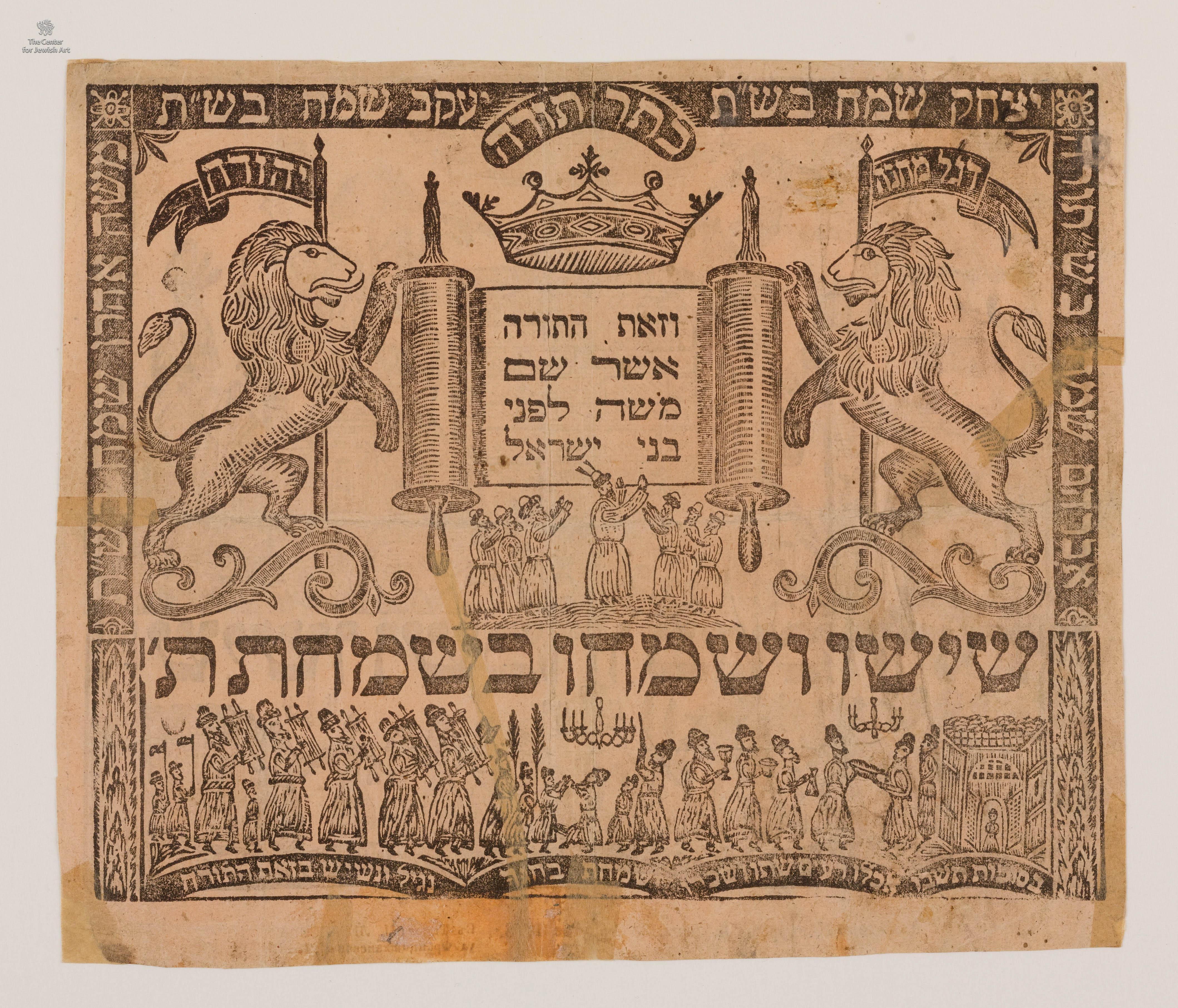
Most communities these days with the practice of reading Torah on Simḥat Torah night read either the first three or the first five ‘aliyot from V-Zot haBerakha, the morning Torah reading from Deuteronomy. However this was not always the case. In many communities throughout eastern Europe, Simḥat Torah night was a time to auction off and read verses of blessing from throughout the entire Torah — called “nedarim” or “vows” in honor of the fact people would pledge money to read them as an aliyah. Many different lists of these verses have come down to us over the years, from as few as three to as many as twenty different readings. Here’s a compilation of ten different lists of “vows,” nine of which were sourced from R. Avraham Yaari’s renowned work “Toldot Ḥag Simḥat Torah” and the tenth of which was submitted by Michael Y. Kopinsky to the “Life in the Fast Lein” Facebook group. Also included are images of the original sources for the ten lists, as well as an original translation of R. Yaari’s passage explaining the custom of the “vows.”
| Source (Hebrew) | Translation (English) |
|---|---|
From R. Avraham Yaari’s Toldot Ḥag Simḥat Torah, 1964, chapter 20, translation mine | |
In some Ashkenazi communities, and afterwards in the lands of Eastern Europe, it was customary to read Torah passages of blessing on Simḥat Torah night after the evening prayer. This custom was not known at all in Spain or Provence or North Africa, nor was it customary in northern France in the days of Rashi and the Tosafists. And it is not known to this day in Sephardic communities, nor in any of the Mizraḥi communities. And even in Ashkenaz this custom is not recorded in the custom-book of the Maharam of Rothenberg, nor in the custom-book of R. Avraham Klausner, nor in the custom-book of his student the Maharil, nor was it customary in Worms. | |
The first time this custom is recorded is in the custom-book of R. Isaac Tyrnau at the end of the fourteenth or beginning of the fifteenth century. | |
This custom is connected to another custom that was newly developed then in Ashkenaz (and there alone): to bring out all the Torah scrolls in the holy ark on Simḥat Torah night after the evening prayer, and encircle them one time around the lectern or “tower,” which was the place of reading the Torah, and to say while doing this, “Please, LORD, save us, please!” etc, and also to sing several stanzas of two piyyuṭim on finishing the Torah. (The custom to orbit it seven times was newly developed a long time later. See below, chapter 30.) The deed was done to honor the Torah that they were about to finish and start again the next day. And since a concern of pointlessly moving Torah scrolls around was raised, not to mention that the deed was done to honor the Torah, they were accustomed to open three of the scrolls that they brought out and roll them to the place from where they would be reading from them the next day: one to the place of the portion V-Zot haBerakha, one to the place of the portion Bereshit, and one to the place of the mafṭir portion, and since that was preparing for the required obligatory readings of the next day there was no longer a concern of pointlessly moving Torah scrolls around. However, in some communities they were not satisfied with merely this, and since they already took out all the Torah scrolls to honor the Torah, they also read from them. Of course, they didn’t read the daily obligatory readings, because the Torah reading is not done at night. Rather, they read different portions of blessing in the Torah, and this was in order to honor the day, which is fundamentally “the day of blessing,” the day on which Solomon blessed the people, and on which they read the blessings of Moses before his death. (See above, chapters 1–3). | |
As mentioned, on Simḥat Torah night they read on different portions of blessing in the Torah, which were called “vows” on account of the fact that they would only call up those who had vowed a certain amount of money for public needs on the sabbaths on which they were read, and since the portions of blessing were beloved by the community they could find many who would jump on it, and many who were prepared to vow substantial sums as long as they could be called up for the reading. And in some communities on Simḥat Torah night they would read the blessings of Moses, which are in the portion portion V-Zot haBerakha — five people, up to Deuteronomy 33:27, as on the next day. | |
R. Isaac Tyrnau, the first to mention this custom, wrote, “On the second day, which is Simḥat Torah… prayer and qaddish like yesterday, and then they take out all the Torah scrolls which are in the ark, and the prayer leader holds a Torah scroll and begins, ‘Please, LORD, save us, please! God of spirits [save us, please]!,’ two or three stanzas, and goes around the tower, along with the people, with the Torah scroll, and in Brno they say ‘for all this.’ Then they roll and find V-Zot haBerakha in the first Torah scroll, and in the second Bereshit, and in the third the additional offering for the eighth day in Pinḥas [for the mafṭir.] The custom in these places is to read all the ‘vows,’ and sing songs, and after that stand with all the Torah scrolls and the prayer leader begins ‘Gather,’ and ‘Rejoice,’ and ‘Happy are you,’ ‘the sprout will come, come!’ [piyyuṭim for the conclusion of the Torah for the next day], two or three verses, and the community responds as such, yehallelu, Adon Olam…”[1] Custom-book of R. Isaac Tyrnau, laws of Shemini ‘Atzeret | |
From Moravia the custom passed on to Poland. The Rema in Darkhei Moshe (§689) brings the words of R. Isaac Tyrnau and writes, “In the Custom-Book: ‘and we take out at night all the Torah scrolls which are in the ark… then they roll and find…’ and the custom [in Poland] is not currently thus, rather they read all the ‘vows’ in the Torah on Simḥat Torah night, and buy the ‘vows,’ and give each who buys a ‘vow’ a mi sheberakh after he goes up to the Torah scroll.” And thus in his notes to the Shulḥan ‘Arukh (§689) he writes: “And also, it is customary in these lands on Simḥat Torah evening and morning to bring out all the Torah scrolls that are in the ark and say songs and hymns… and also they are accustomed to orbit the lectern in the synagogue with the Torah scrolls [one time] just as they orbit with the lulav, and all in the name of joy… and at night they read in the Torah scroll the ‘vows’ that are in the Torah, but every place follows its custom.” R. Mordecai Yoffe, author of the Levushim, wrote, almost word-for-word according to what R. Isaac Tyrnau said, “and after that [after the evening service] they take out all the Torah scrolls in the ark… and he goes around the tower along with the people with the rest of the Torah scrolls, and they roll three Torah scrolls to be prepared for the portions to be read tomorrow… and in some places they have the custom to read all the ‘vows’ and sell them…”[2] R. Mordecai Yoffe’s Levush ha-Ḥur, §689 | |
What are these portions of blessing in the Torah which were customary to read on Simḥat Torah night and which were called “vows” since it was customary to vow upon them community needs? Many different lists of these blessing-portions, the “vows,” have come down to us, some short and others long. | |
Note: Verses listed in (parentheses), as well as verses not bracketed whatsoever, are specified in the original text with regards to the beginning and ending of the reading. Verses listed in [square brackets] are not, and their beginning and ending are reconstructed based on parallel lists. The Sefer la-Ḥazanim lists starting verses but not ending verses, which are reconstructed. | |
R. Ephraim Zalman Margolioth[3] R. Ephraim Zalman Margolioth’s Sha’arei Ephraim, on the laws of Torah readings, Dubno, 1820, gate 8, ¶57. • Va-Ykhulu [Genesis 2:1–3] • Ha-Mal’akh Ha-Goel [Genesis 28:14–17] • the priestly blessing [Numbers 6:22–27] • “and other verses of blessing.” | |
Ashkenazi community synagogue in Amsterdam[4] The Leadership of the Synagogue of the Ashkenazi Community in Amsterdam, Amsterdam 1815, §3, ¶1 • V-Yiten Lekha [Genesis 27:27–29] • Ha-Mal’akh Ha-Goel [Genesis 28:14–17] • Li-yshu’atkha [Genesis 29:16–18] • Va-Yisa’ [Exodus 14:19–31] • the Song of the Sea [Exodus 15:1–18] • the Ten Commandments [Exodus 20:1–14, Deuteronomy 5:6–18] • the priestly blessing [Numbers 6:22–27] | |
Record-book of the Old Synagogue of Poznan[5] Record-Book of the Old Synagogue of the Poznan Community, NLI 8°2469, p. 11. See also S. K. Mirsky, in his book “Brakha li-Menaḥem,” the Festschrift to honor R. Menaḥem Tzvi Eichenstein, St. Louis, 1955. • From the portion Bereshit, ◦ the vow of Va-Ykhulu (Genesis 2:1–3) – sold to a levite. • From the portion Va-Yḥi, ◦ the vow of Me-El Avikha (Genesis 49:22–26); ◦ the vow of Li-yshu’atkha (Genesis 29:16–18). • From the portion B-Shallaḥ, ◦ the vow of Va-Yisa’ (Exodus 14:19–25), ◦ and the vow of Az Yashir (Exodus 15:1–26) • From the portion Yitro: ◦ the vow of Anokhi (Exodus 20:1–14) • From the portion Naso: ◦ the vow of Y’varekhekha (Numbers 6:22–27) • From the portion of B-ha’alotkha: ◦ the vow of Va-Yhi Bi-nsoa’ (Numbers 10:33–36) • From the portion of Ḥuqat: ◦ the vow of Az Yashir (Numbers 21:17–20) • From the portion of Balaq: ◦ the vow of Ma Ṭovu [Numbers 24:2–5] which is a vow for Simḥat Torah but not for the weekly portion. • From the portion of Va-Etḥanan: ◦ the vow of Anokhi (Deuteronomy 5:6–18), ◦ and the vow of Shma’ (Deuteronomy 6:4–9) | |
Sefer le-Ḥazanim[6] Songs and Hymns Arranged for Prayer-Leaders, Wrocław (Breslau) 1846, p. 12 1. The vow of Va-Ykhulu in the portion of Bereshit, Genesis 1:31 [to 2:3] 2. The vow V-Yiten Lekha in the portion of Toldot, Genesis 27:27 [to 29] 3. The vow of Ha-Mal’akh in the portion of Va-Yḥi, Genesis 48:15 [to 16!] 4. The vow of Li-yshu’atkha in the portion of Va-Yḥi, Genesis 49:16 [to 18] 5. The vow of Me-El Avikha in the portion of Va-Yḥi, Genesis 49:22 [to 26] 6. The vow of Va-Yosha’ in the portion of B-Shallaḥ, Exodus 14:29 [to 15:18] with the song 7. The vow of Va-Yomer in the portion of B-Shallaḥ, Exodus 15:23 [to 26] 8. The vow of Anokhi in the portion of Yitro, Exodus 20:1 [to 14] 9. The vow of Y’varekhekha in the portion of Naso, Numbers 6:22 [to 27] 10. The vow of Va-Yhi Bi-nsoa’ in the portion of B-ha’alotkha, Numbers 10:33 [to 36] 11. The vow of Az Yashir in the portion of Ḥuqat, Numbers 21:14 [to 20] 12. The vow of Ma Ṭovu in the portion of Balaq, Numbers 24:2 [to 5] | |
R. Dov Ber David Reifman[7] R. Dov Ber David Reifman’s Shulḥan ha-Qriah, the laws of reading the Torah, Vilnius 1864, reprinted Berlin 1882, §21. 1. Genesis 1:1–2:3 2. Genesis 15:4–6 3. Genesis 17:3–6 4. Genesis 27:27–29 5. Genesis 28:1–4 6. Genesis 28:20–22 7. Genesis 48:14–16 8. Genesis 49:16–18 9. Genesis 49:22–26 10. Exodus 15:22–26 11. Exodus 30:11–16 12. Exodus 35:1–29 – this can be divided in two [perhaps 35:1–20 and 21–29] 13. Numbers 6:24–26 14. Numbers 10:33–36 15. Numbers 21:1–3 16. Numbers 24:2–5 17. Deuteronomy 33:27–29 | |
The old study hall of Berlin[8] Customs of the Old Study Hall of the Berlin Community, Which I Printed According to What I Received From My Antecedents… Chaim Biberfeld, Berlin, 1937, p. 3 1. Genesis 1:28–31 2. Genesis 48:14–16 3. Exodus 15:20–26 4. Leviticus 26:3–9 5. Numbers 6:22–27 6. Deuteronomy 7:12–15 7. Deuteronomy 28:1–6 8. “If necessary one can also read Deuteronomy 6:4–9, Deuteronomy 33 etc.” | |
R. Chaim Halberstam:[9] Sukat Shalom, Seder ha-Ushpizin v-Seder ha-Haqafot, Warsaw 1891; Seder Haqafot per the custom of R. Chaim Halberstam, av beit din of Sanz, Lviv 1889 • Kohen: Genesis 27:24–33 • Levi: Genesis 48:10–16 • Third: Genesis 49:8–26 • Fourth: Numbers 6:22–27 • Fifth: Numbers 24:1–13 | |
R. Elimelekh of Lizhensk:[10] Seder Nusaḥ Haqafot b-Beit Midrasho shel-R. Elimelekh mi-Lizensk, Cluj, 1925 • Kohen: Numbers 6:22–27 • Levi: Numbers 10:29–36 • Third: Numbers 21:10–20 • Fourth: Numbers 24:1–5 | |
R. Israel of Kozhnitz:[11] Tefillah l-Moshe, on Sukkot, of R. Moshe Elyakim Briah, son of the Maggid R. Israel of Kozhnitz, Lviv 1866, p. 38 • Kohen: Genesis 27:24–29 • Levi: Genesis 48:11–16 • Israel: Numbers 24:1–13 | |
Maḥzor Rabba[12] Eshkol Press, c. 1960s • Genesis 1:1–2:3 • Genesis 9:1–7 • Genesis 12:1–3 • Genesis 14:18–20 • Genesis 17:1–6 • Genesis 21:1–8 • Genesis 22:15–24 • Genesis 27:27–29 • Genesis 28:1–4 • Genesis 35:9–11 • Genesis 48:14–16 • Genesis 49:1–28 • Exodus 20:1–14 • Exodus 23:20–25 • Leviticus 16:28–30 • Leviticus 22:26–23:44 • Numbers 6:22–7:89 • Numbers 10:35–36 • Numbers 24:3–5 • Deuteronomy 15:19–16:17 |
Notes
| 1 | Custom-book of R. Isaac Tyrnau, laws of Shemini ‘Atzeret |
|---|---|
| 2 | R. Mordecai Yoffe’s Levush ha-Ḥur, §689 |
| 3 | R. Ephraim Zalman Margolioth’s Sha’arei Ephraim, on the laws of Torah readings, Dubno, 1820, gate 8, ¶57. |
| 4 | The Leadership of the Synagogue of the Ashkenazi Community in Amsterdam, Amsterdam 1815, §3, ¶1 |
| 5 | Record-Book of the Old Synagogue of the Poznan Community, NLI 8°2469, p. 11. See also S. K. Mirsky, in his book “Brakha li-Menaḥem,” the Festschrift to honor R. Menaḥem Tzvi Eichenstein, St. Louis, 1955. |
| 6 | Songs and Hymns Arranged for Prayer-Leaders, Wrocław (Breslau) 1846, p. 12 |
| 7 | R. Dov Ber David Reifman’s Shulḥan ha-Qriah, the laws of reading the Torah, Vilnius 1864, reprinted Berlin 1882, §21. |
| 8 | Customs of the Old Study Hall of the Berlin Community, Which I Printed According to What I Received From My Antecedents… Chaim Biberfeld, Berlin, 1937, p. 3 |
| 9 | Sukat Shalom, Seder ha-Ushpizin v-Seder ha-Haqafot, Warsaw 1891; Seder Haqafot per the custom of R. Chaim Halberstam, av beit din of Sanz, Lviv 1889 |
| 10 | Seder Nusaḥ Haqafot b-Beit Midrasho shel-R. Elimelekh mi-Lizensk, Cluj, 1925 |
| 11 | Tefillah l-Moshe, on Sukkot, of R. Moshe Elyakim Briah, son of the Maggid R. Israel of Kozhnitz, Lviv 1866, p. 38 |
| 12 | Eshkol Press, c. 1960s |
“🗐 Lists of “Vows” or Alternate Readings for Simḥat Torah Night” is shared through the Open Siddur Project under the Creative Commons Attribution-ShareAlike (CC BY-SA) 4.0 International copyleft license.



Leave a Reply