![the Open Siddur Project [logo]](https://opensiddur.org/wp-content/uploads/2018/09/Open-Siddur-Project-Logo-2016.svg)
Note: For clarity, we have replaced the use of the Solidus (a/k/a “forward slash”) as found in the Fraktur script of the printed work, with its equivalent — the comma.
| Source translation (German) | Translation (Modern German) | Translation (English) | Abridged Source (Hebrew) |
|---|---|---|---|
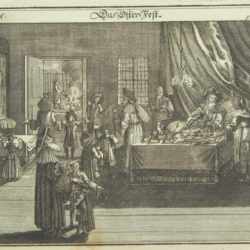
Die Ceremonien, welche gebraucht werden bey den zwey Oster-Nächten mit grosser Andacht gebetten und vollbracht , und lauten also auß ihrem Kabala: |
Die Zeremonien, welche gebraucht werden bei den zwei Osternächten mit großer Andacht gebeten und vollbracht, und lauten also aus ihrem Kabbala: |
The ceremonies required during the two paschal[1] Literally: “Easter.” Uncommon in modern German usage, at the time both Passover and Easter were referred to as such. This is still the case in many languages — see Greek Πάσχα των Ιουδαίων, French Pâque juive, Finnish juutalainen pääsiäinen, and Spanish pascua de los judíos. Note, though, that in all three of those languages, the word for Easter derives from the Hebrew פֶּסַח via Aramaic, which is not the case in German — or in English. nights, which are solemnly prayed and performed, are as follows from their Kabbalah: | |
Allmächtiger Gott, nun bau dein Tempel Schyro also in Schier und alsobald in unseren Tagen Schyro ja Schiro. |
Allmächtiger Gott, nun bau’ dein Tempel schiere, also in schier und also bald, in unseren Tagen schiere, ja schiere! |
Almighty God, now build Your Temple soon, both soon and also quick, in our days, soon, yeah, soon! |
אַדִּיר הוּא יִבְנֶה בֵּיתוֹ בְּקָרוֹב בִּמְהֵרָה, בִּמְהֵרָה, בְּיָמֵינוּ בְּקָרוֹב (אֵל בְּנֵה בֵּיתְךָ) בְּקָרוֹב׃ |
Barmhaffter GOtt, grosser GOtt, demühtiger GOtt, hoher GOtt, feiner GOtt, Süsser und demühtiger GOtt, Jüdischer GOtt, nun bau dein Tempel Schyro also Schier und alsobald, und baue dein Tempel Schiro. |
Barmherziger Gott, großer Gott, demütiger Gott, hoher Gott, feiner Gott, süßer und demütiger Gott, jüdischer Gott, nun bau’ dein Tempel schiere also schier und also bald, und bau’ dein Tempel schiere! |
Merciful God, great God, humble God, high God, nice God, sweet and humble God, Jewish God, now build Your Temple soon, both soon and also quick, and build Your Temple soon! |
בָּחוּר הוּא גָּדוֹל הוּא דָּגוּל הוּא הָדוּר הוּא וָתִיק הוּא זַכַּאי הוּא חָסִיד הוּא… יָחִיד הוּא יִבְנֶה בֵּיתוֹ בְּקָרוֹב בִּמְהֵרָה, בִּמְהֵרָה, אֵל בְּנֵה בֵּיתְךָ בְּקָרוֹב׃ |
Kräfftiger lebendiger mächtiger Namhaffter ewiger forchtsammer reicher Königlicher waherer schöner GOtt, nun bau dein Tempel Schyro also schier und alsobald in unseren Tägen[2] Probably a typo for Tagen Schiro. Nun baue dein Tempel Schiro. |
Kräftiger lebendiger mächtiger namhafter ewiger furchtsamer reicher königlicher wahrer schöner Gott, nun bau’ dein Tempel schiere also und also bald, in unseren Tagen schiere, nun bau’ dein Tempel schiere! |
Strong, living, mighty, renowned, eternal, awesome, sovereign, royal, true, beautiful God, now build Your Temple soon, both soon and also quick, in our days, soon, and build Your Temple soon! |
כַּבִּיר הוּא לָמוּד הוּא מֶלֶךְ הוּא נָאוֹר הוּא…עִזּוּז הוּא פּוֹדֶה הוּא… קָדוֹשׁ הוּא רַחוּם הוּא צַדִּיק הוּא[3] The divine attribute/epithet corresponding to “wahrer” (true) in the original Hebrew is unclear and my associating it with “tsaddiq” is speculative given the deviation from the original alphabetic acrostic. As “tahor” (pure) was skipped earlier in the acrostic, perhaps that is the correct corresponding attribute. –Ahaon Varady שַׁדַּי הוּא… יִבְנֶה בֵּיתוֹ בְּקָרוֹב בִּמְהֵרָה, בִּמְהֵרָה, בְּיָמֵינוּ בְּקָרוֹב. אֵל בְּנֵה בֵּיתְךָ בְּקָרוֹב׃ |
This is the early piyyut “Adir Hu” in a German variant of its Western Yiddish adaptation “Baugensang” as attested by Paul Christian Kirchner in his Jüdisches Ceremoniel (1717), p. 127. For comparison, I have added the text of Adir Hu as it would correspond to this variant of the Baugesang. The alphabetic acrostic of the original piyyut is abridged in this translation. As the acrostic is broken in several places, it is unclear whether this variant itself is abbreviated or whether the translation is abridged. All elisions in the Baugesang are indicated with elipses in the Hebrew text of Adir Hu. –Aharon Varady
Source(s)

Jüdisches Ceremoniel (Paul Christian Kirchner, 1717), p. 127
Notes
| 1 | Literally: “Easter.” Uncommon in modern German usage, at the time both Passover and Easter were referred to as such. This is still the case in many languages — see Greek Πάσχα των Ιουδαίων, French Pâque juive, Finnish juutalainen pääsiäinen, and Spanish pascua de los judíos. Note, though, that in all three of those languages, the word for Easter derives from the Hebrew פֶּסַח via Aramaic, which is not the case in German — or in English. |
|---|---|
| 2 | Probably a typo for Tagen |
| 3 | The divine attribute/epithet corresponding to “wahrer” (true) in the original Hebrew is unclear and my associating it with “tsaddiq” is speculative given the deviation from the original alphabetic acrostic. As “tahor” (pure) was skipped earlier in the acrostic, perhaps that is the correct corresponding attribute. –Ahaon Varady |
“בּױגעזאנג | Baugesang (Building Song): a German adaptation of the piyyuṭ Adir Hu attested by Paul Christian Kirchner in his Jüdisches Ceremoniel (Nuremberg, 1717)” is shared through the Open Siddur Project under the Creative Commons Attribution-ShareAlike (CC BY-SA) 4.0 International copyleft license.








Leave a Reply