Contributor(s): Shared on: 14 June 2026 under the Creative Commons Zero (CC 0) Universal license a Public Domain dedication Categories: Tags:
Guest Chaplain: Rev. Dr. Martin A. Meyer, rabbi Temple Emanu-El, San Francisco, California
Sponsor: n/a
Date of Prayer: 13 January 1915
| Contribute a translation | Source (English) |
|---|
|
God of the nations,
may the spirit of knowledge and of good will,
of peace and understanding,
rest upon the assembled deputies of our Nation,
so that justice may abound in our land,
that wisdom and harmony may direct their councils
in the spirit of righteousness.
Lead these, Thy servants, in the paths of peace. | |
May Thy divine guidance be our portion,
so that this people, dedicated to liberty and fraternity,
may ever be the stay and guidance of man and humanity;
leading to the mountains of love and light. | |
O God,
grant strength to the leaders of the people. | |
O Lord,
bless our Nation with peace.
Amen. |
This prayer of the guest chaplain was offered in the second month of the third session of the 63rd US House of Representatives, and published in the Congressional Record, vol. 52 part 2 (13 January 1915), page 1514. Source(s)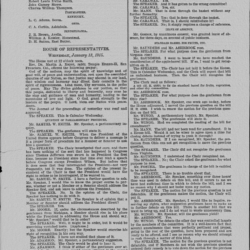 Prayer of the Guest Chaplain – Martin A. Meyer (House of Representatives, 13 January 1915), p. 1514 “Prayer of the Guest Chaplain of the U.S. House of Representatives: Rabbi Martin A. Meyer on 13 January 1915” is shared through the Open Siddur Project under the Creative Commons Zero (CC 0) Universal license a Public Domain dedication.
Aharon Varady (M.A.J.Ed./JTSA Davidson) is a volunteer transcriber for the Open Siddur Project. If you find any mistakes in his transcriptions, please let him know. Shgiyot mi yavin; Ministarot naqeni שְׁגִיאוֹת מִי־יָבִין; מִנִּסְתָּרוֹת נַקֵּנִי "Who can know all one's flaws? From hidden errors, correct me" (Psalms 19:13). If you'd like to directly support his work, please consider donating via his Patreon account. (Varady also translates prayers and contributes his own original work besides serving as the primary shammes of the Open Siddur Project and its website, opensiddur.org.)  Rabbi Martin Abraham Meyer (1879–1923), born in San Francisco, was a prominent Reform movement rabbi and scholar n the United States. He was a disciple of Jacob Voorsanger, the rabbi of Congregation Emanu-El, and with his encouragement went to Hebrew Union College in Cincinnati, Ohio. He graduated with an A.B. degree from the University of Cincinnati in 1899. In 1901, he was the honor man and valedictorian of his class when he graduated from Hebrew Union College with a B.D. After graduating, he became a Fellow of the American School of Oriental Study and Research in Palestine in Jerusalem. He was there from 1901 to 1902, studying archaeology, ethnology, and Semitic philology while writing several important articles for Jewish periodicals on the condition of Jews in Ottoman Palestine. He also received a Ph.D. from Columbia University in 1906, where he was a student of Professor Richard Gottheil. Meyer first served as rabbi of Congregation Beth Emeth in Albany, New York, from 1902 to 1906. Afterward, he served Temple Israel in Brooklyn from 1906 to 1910, and then, from 1910 until his death, Congregation Emanu-El in San Francisco. He became one of the leading rabbis of the Pacific Coast. He was president of the California Conference of Social Work, the Big Brother Movement of San Francisco, the Pacific Coast Branch of the Jewish Chautauqua, and the Young Men's Hebrew Association. He was a member of the California Commission of Charities and Corrections from 1911 to 1920, serving as its president for eight years, and a vice-president of the Jewish Publication Society of America. During World War Ⅰ, he served with the American Red Cross in France from 1918 to 1919. He was also a member of, among other national Jewish committees, the American Jewish Congress, the Zionist Organization of America, and the Palestine Restoration Fund. Meyer's 1907 dissertation, History of the City of Gaza, was a scholarly work on Arabic Semitic culture. In 1904, he wrote the article "Jerusalem-Modern" for The Jewish Encyclopedia. He also wrote an introduction to I. M. Wise's Sermons and Addresses by Jacob Voorsanger in 1913, a pamphlet for the Central Conference of American Rabbis called Jew and Non-Jew in 1913, and a sketch of "Jews in California" that was in A.M. Voorsanger's Western Jewry in 1916. He was one of the few Reform rabbis at the time to openly support Zionism. Deeply interested in social service problems, he and I. Irving Lipsitch founded the Jewish Committee for Personal Service in State Institutions. He also wrote the two-volume Methods of Teaching Post-Biblical History and Literature in 1915. He helped organize small Jewish communities in the San Francisco area, and was a director of the Jewish Education Society of San Francisco. Meyer was a director of the First Hebrew Congregation of Berkeley, a lecturer of Jewish history at the University of California from 1911 until his death, chairman of the North California branch of the Jewish Welfare Board, editor of Emanu-El in 1911 and an editorial contributor from 1913 until his death, and a member of the Commonwealth Club, the Faculty Club, the Concordia Club, the Beresford Club, the American Jewish Historical Society, the Society of Biblical Literature and Exegesis, and the American Oriental Society. He was the commencement speaker at the University of California in 1920, and in 1921 he delivered the convention address at the biennial Union of American Hebrew Congregations convention and the baccalaureate address before the graduating Hebrew Union College class. Meyer was an organizer of the Brooklyn Federation of Jewish Charities. He lectured at Leland Stanford University, the University of Nevada, and Hahnemann Medical College several times. He cooperated with the Menorah Society at the University of California in arranging its cultural programs. He gave special seminars in Berkeley and San Francisco for students planning on entering the rabbinate. His library of Judaica and general religious and philosophical literature was one of the largest private collections in the country. He was a director of the San Francisco branch of the Archaeological Institute of America and a member of the board of consulting editors of the Menorah Journal when it was launched in 1915 The Congressional Record is the official record of the proceedings and debates of the United States Congress, published by the United States Government Printing Office and issued when Congress is in session. Indexes are issued approximately every two weeks. At the end of a session of Congress, the daily editions are compiled in bound volumes constituting the permanent edition. Statutory authorization for the Congressional Record is found in Chapter 9 of Title 44 of the United States Code. ( wikipedia) Read a comment / Leave a comment (moderated) Works of related interest: |
![the Open Siddur Project [logo]](https://opensiddur.org/wp-content/uploads/2018/09/Open-Siddur-Project-Logo-2016.svg)




Leave a Reply