
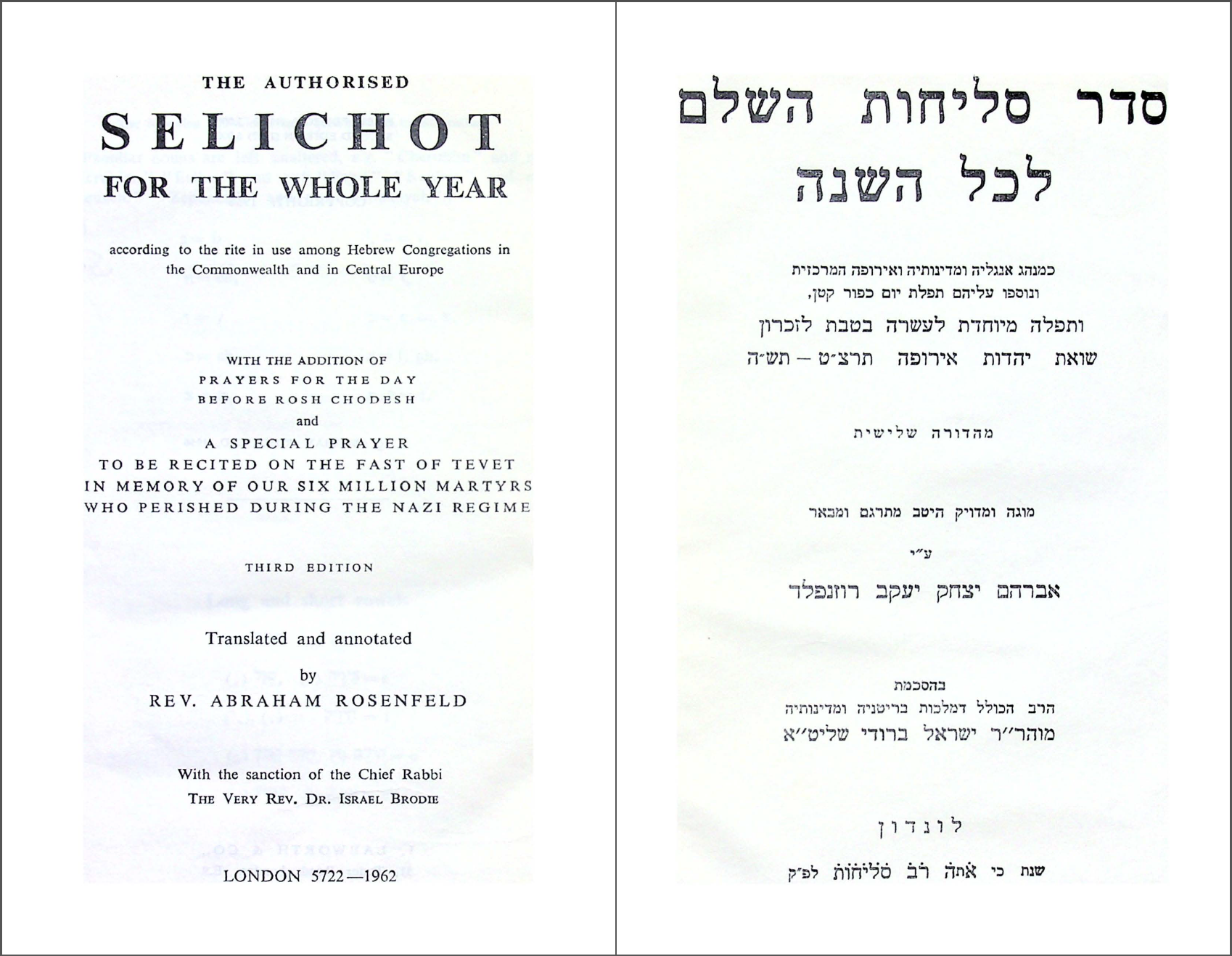
סדר סליחות השלם לכל השנה The Authorised Selichot for the Whole Year (1965) is a comprehensive Hebrew-English maḥzor for memorial days in the rabbinic Jewish religious calendar according to the liturgical custom of Ashkenaz, as prepared by Rabbi Abraham Rosenfeld (1914-1984) under supervision of the Office of the Chief Rabbi of the United Hebrew Congregations of the United Kingdom and Commonwealth, Rabbi Israel Brodie. The prayerbook also contains a memorial prayer for victims of the Holocaust.


INTRODUCTION
Meaning of Selichot
The term Selichah (pl. Selichot) means literally ‘‘forgiveness” and is thus applied to prayers for forgiveness. It is used to describe penitential prayers which are not generally an integral part of the service but are recited on certain solemn days of the Jewish calendar. The Selichot in this volume are those recited on the days preceding Rosh Hashanah, on the days between Rosh Hashanah and Yom Kippur, and on certain Fast Days. Special Selichot recited on Yom Kippur appear in the Machzor and are not included in this collection.
Origin of Selichot
The Synagogue service consisted originally mainly of biblical passages, selected and grouped to fit the occasion. The term Selichot was at first applied to the verses selected for Yom Kippur. Later, when to these verses were added other prayers of a penitential character, the whole was termed Selichot. The earliest of these other prayers in the Selichot collections were very simple. One of them, beginning with ‘Mi-she-anah’ (see p. 19) is mentioned in the Talmud (Taanit 15a) as having been recited in the service on Fast Days. Other well-known early Sefichot are ‘Aval Anachnu Chatanu’ (see p. 16), the recital of the “Thirteen Attributes of God” and the introductory passage to ‘El Melech Yoshey’ (sec pp. 7 and 9).
According to the Mishnah tractate Taanit, ch. 2, the service on public Fast Days (such as the 10th of Tevet, the Fast of Esther and the 17th of Tammuz, etc.) was opened with verses and prayers exhorting the worshippers to repentance. These may be regarded as the earliest Selichot composed for use in the Synagogue.
Development of Selichot
It is known that many Selichot were composed before the 7th century of the current era. It is generally held that the lack of records of their composition is due to an early prohibition against copying holy writ, including prayers. At the request, however, of the Spanish Jews in the 9th century, Rav Amram Gaon (856-874) agreed to write down the daily prayers, together with some Selichot, which were incorporated in his Siddur.
At this period, apparently, Selichor were said only during the Ten days of Penitence and not, as is the present custom, also for a week before Rosh Hashanah. The extension of the use of Selichot to the days before Rosh Hashanah was to provide a preparation for the Day of Judgment, and the ruling of Rav Hai Gaon (d. 1038) shows that the Sephardim introduced such prayers for the whole month of Elul.
Many of the early Selichot in our present collections were composed in Italy. For instance, a number were composed in the communities of the South of Italy under Byzantine rule in the 9th and 10th centuries. Especially noteworthy were the synagogal poets of the family of Amittai of Oria (whose compositions still feature prominently in our Neilah Service of the Day of Atonement). Amittai’s son, Shephatyah (d. 886), wrote Selichot in a pure Hebrew, with the name in acrostic, but not in alphabetical order. Another of the South Italian poets was Zevadyah, whose Selichot were written in varying rhyme and alphabetical acrostic.
The transmission of rabbinical learning, poetic skill and mystical tradition, originally inspired by Babylonian Jewry, passed from the South of Italy, through Central and Northern Italy, to the Rhineland and France, and is particularly associated with the family of Kalonymus. Among the liturgical poets of this family in the earlier period, may be mentioned Rabbi Meshullam ben Kalonymus, who flourished at Lucca in the 10th century.
The names of other and later authors of Selichot are listed in the Appendix, which gives, so far as available, biographical details of the writers of the Selichot in this volume.
Subjects of Selichot
They can be grouped, on the basis of subject, into four broad classes, though these later developed a number of variants within the classes:—
(a) The ‘Tochachah’ (admonition), in which the soul is called upon to consider its destiny and purpose. The themes are the shortness and vanity of life, the value of penitence, the Day of Judgment, the conflict between reason and passion, and between spirit and body.
(b) The ‘Akedah’ (sacrifice of Isaac), the moving story of the patriarch which forms the subject of many Selichot. In most cases the story is used to represent the martyrdom of the thousands of Jews who were sacrificed because they were the people of God.
Each of them is likewise considered an Akedah and their merit is invoked as a plea to God to forgive the sins of his people for the sake of the martyrs.
(c) The ‘Techinah’ (supplication) and (d) ‘Bak k (petition) types represent the relationship between God and Israel. The wishes and desires of the individual are merged with those of the community as a whole, for it is not the individual alone who pleads but the congregation. Often in these pleas the Angel of Mercy, the Torah, and the Throne of God are called upon to intervene on behalf of Israel.
Structure of Selichot
In form, the prayers designated Selichot are, like other Piyyutim or liturgical poems, described as ‘ Petichot’ (prologues), with which prayers are opened, as, indeed, the Selichot themselves are introduced by Petichot. They have equal rhyming throughout and no introductory verses. The Selichot take the form of a ‘Sheniyah’ (of two-lined strophes), ‘Shelishiyah’ (of three-lined strophes) and ‘Shalmonit’ (of four-lined strophes). Selichot of more than four lines are found only in Pizmonim (v. Pizmon), and belong to the period beginning with Ibn Gabirol (1021-1056).
Pizmon
Hymn with a refrain; usually the chief poem of the Selichot sung or recited by the Reader and mepeated by the Congregation. Some Pi: im such as “ hah’; ‘Yisrael Nosha’, ‘Zechor Brit’, are distinguished by a special traditional melody, and others are chanted to a general melody (v. J.E. ‘Selichot’).
Certain Selichot are arranged merely in alphabetical order, without divisions. The alphabetical tradition (including the practice of using the alphabet backwards, starting with the last letter) has often persisted in Selichot whose verses are not arranged alphabetically. These, nevertheless, have as the first word of the Selichah a word beginning with the first or last letter of the alphabet (Aleph or Tav). Some Selichot were composed in groups, as each begins with the final word of the preceding Selichah.
Editions of Selichot
The earliest edition of the Selichot was that of Meshulam Cusi, printed at Pieve di Sacco (1475 ?). Then followed an edition of the Roman rite (Soncino 1487) and that of Prague (1529). The German tite was published by Meir Katzenellenbogen at Padua in 1546.
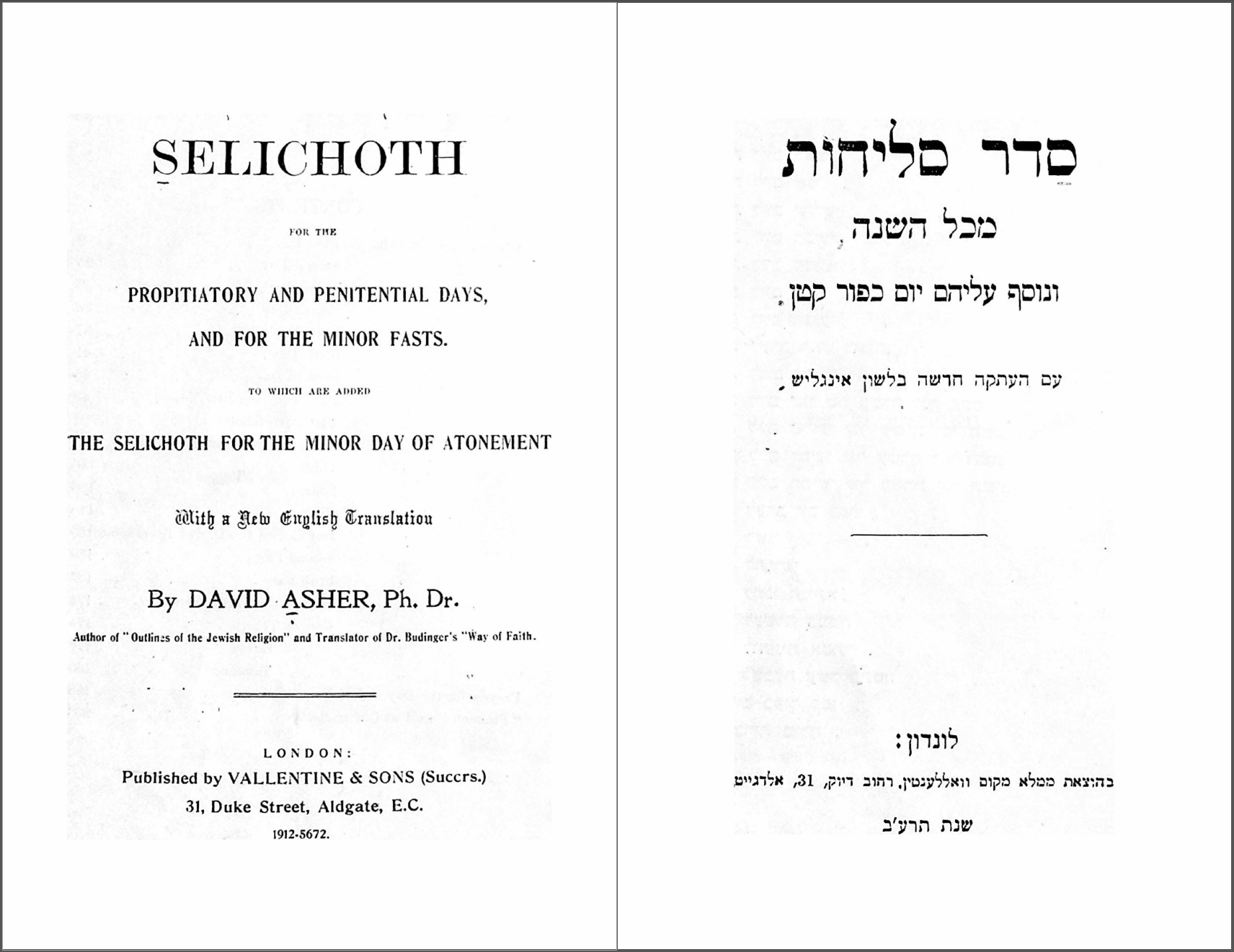
The Polish rite was published in 1584 at Cracow. A German translation of the Polish rite was published at Frankfort-on-Oder in 1602, and in 1671 German translations of both Polish and German rites. The first Yiddish translation of the Ashkenazic Selichot appeared in Prague in 1602, and in Amsterdam in 1688. An edition according to the Polish, Austrian, Danish and English rites was published in 1840. The first English translation of the Selichot was that of Dr. David Asher, who copied much from the German version of M. Blogg of Hanover; he incorporated the English version by the Rey. D.A. de Sola of those Selichot which appeared in de Sola’s Machzor for the Day of Atonement.
The Present Edition
The Asher edition of 1866 could not be reprinted as some of the plates of the original English version were missing. Not only was there no English translation of the Selichot available, but none of the many Hebrew texts published during the last fifty years accord with the rite that has developed in Britain and Western Europe. Worshippers in our congregations in the past have not unreasonably complained that they have no standard text in which to follow the Selichot service, and no English translation of prayers which are both unfamiliar and, for the most part, written in a complex and allusive style.
I therefore decided, with the constant encouragement of the Chief Rabbi, the Very Rev. Rabbi Israel Brodie נ״י to undertake the publication of a standard edition with a revised translation, and at the same time incorporate a special prayer in memory of the Six Million of our brethren who were exterminated during the Nazi Regime, which is to be recited on the Fast of Tevet (see p. 349).
For the text, I used all the available copies of the Selichot in the Oriental Department of the British Museum Library, and have tried to eliminate many grammatical errors which were to be found in the earlier editions. To bring out clearly the distinction between the full חוֹלָם and the defective, I have adopted the full form wherever the case may require it, e.g. רוֹעֶה instead of רֹעֶה; רְחוֹבוֹת instead of רְחֹבוֹת (which is almost invariably found in the Bible.) Direct verbatim quotations from the Bible, have, however, been left unaltered. The vertical line (Meteg) has been added to indicate the accent where it is not on the last syllable.
The introductory verses to the Psalms on p. רפא are adapted to follow the style of the original compilers who chose the introductory verses to resemble the main Selichah.
In the translation, my object has been to keep as faithfully as possible to the meaning of the original, even at the cost of some inelegance in the style of the English, while avoiding conscious archaisms; for instance, the use of “thou” has been limited to reference to the Almighty. Otherwise, in rendering the biblical passages, I have followed mainly the Revised Version. Generally, the translation and notes have been based on the ‘Matte-Levy’ and ‘Biur’. Sources of biblical quotations have been added in the notes and each prayer is prefaced with the name of the author, whenever this is known. In these attributions I have followed the standard authorities, notably Leopold Zunz, Eliezer Landshuth, S. Baer, Israel Davidson, Ismar Elbogen, S. J. Schirmann, H. Brody and A. M. Haberman. It is particularly appropriate that this new English rendering of the Selichot should appear in the civic year 1956, which marks the Tercentenary of the resettlement of the Jewish people in Britain.
Acknowledgments
The accomplishment of this venture has been made possible by the generosity of my dear friend E. Alec Colman and some of the members of my Community who have materially assisted in meeting the cost of publication, and enabled this book to be obtained for the price of Seven Shillings and Sixpence. All those who use this volume with profit owe them gratitude.
I must pay special tribute to my dear wife, who read through the entire manuscript. I must thank also, for valuable help and assistance in proof reading, Dr. Isidore Fishman, M.A., Dr. S. Fundaminsky, B.A., Mr. V. D. Lipman, M.A.(Oxon), D.Phil., the late Mr. Maurice Simon, M.A., and Mr. N. Weinberg (of Williams, Lea, Printers). Mr. Cyril Moss of the Department of the Oriental Printed Books and MSS of the British Museum, has always been most helpful to me in providing me with information. All of them have made most valuable suggestions but the responsibility for text, translation and notes is, of course, my own, as is that for any errors which may have occurred. I gratefully acknowledge the permission of Messrs. Shapiro, Valentine and Co., to use Dr. Asher’s translation wherever necessary.
In conclusion, I trust that this new edition of the Selichot will prove of help to those who desire a fuller knowledge of the prayers they offer during the solemn days, when we stand for judgment before the Architect of the Universe. I offer it in thankfulness to him for his goodness bestowed on me, in the hope that it may deepen the devotion of those who pray to him in supplication for his forgiveness.
ותקבל ברחמים וברצון את תפלתינו
ABRAHAM ROSENFELD
FOREWORD TO THE SECOND EDITION
It was a matter of pleasant surprise to me to learn that the first edition of the Selichot, translated and edited by the Rev. Abraham Rosenfeld, had been completely sold out and that there was a continuing demand fora second edition.
I have heard this edition of the Selichot commended by many members of our community who made use of it during the Penitential season. Its popularity is due not merely to the fact that it is sold at a low cost, but to its handy format and excellent Hebrew text as well as to its accurate translation and valuable notes.
I am sure that the author and those who assisted him in preparing this book appreciate and are grateful for the recognition this work has been so generously accorded.
This present edition of the Selichot makes the Supplications and Penitential Prayers more accessible and intelligible to worshippers. May it lead to a deeper realisation of the Divine Providence and to an increased devotion among those who make use of it.
ISRAEL BRODIE, Chief Rabbi.
30th May, 1957—5717.
NOTE TO THE SECOND EDITION
This second edition has been thoroughly revised and corrected wherever possible. In this connection, I wish to express my grateful thanks to Rabbi Dr. Wolf Gottlieb and Mr. Abbie Goldstein (New York) who drew my attention to certain errors in the first edition.
I have been informed by my ministerial colleagues that attendances at the Selichot Services during the solemn days were far greater than ever before. It must also be regarded as remarkable that the first edition of three thousand copies was exhausted in twelve days. I am therefore thankful to the Almighty for having fulfilled my expressed hope ‘that this edition will prove of help to those who seek a fuller knowledge of the Prayers’.
I regret however that a rise in the cost of production no longer allows this volume to be sold at the original price of seven shillings and sixpence, and an increase to TWELVE SHILLINGS AND SIXPENCE is therefore unavoidable.
Abraham Rosenfeld
LONDON, Sivan, 5717—June, 1957.
NOTE TO THE THIRD EDITION
The demand for a third edition of this Selichot has come sooner than I have anticipated; it is indeed gratifying to learn that this work has been accepted throughout the English-speaking world, even in places as far apart as Trinidad and Hong Kong.
The author is indebted to Mr. E. Alec Colman who gave a generous subsidy towards the cost of this edition in order to place it within the reach of the community at large. It is nevertheless, regrettable that owing to recent rises in the cost of production, the charge for this volume has been increased to SEVENTEEN SHILLINGS AND SIXPENCE.
It was unfortunate, that because of the great demand for the second edition and its consequent hurried preparation, certain printing errors occurred. However, I have proceeded as far as possible to eliminate them, and I trust that the worshippers will find this new edition an encouragement to pray fervently to the Supreme Judge. May he hearken to our prayers, and grant us many good years of peace and happiness.
Abraham Rosenfeld
LONDON, Elul, 5722—September, 1962
ACKNOWLEDGEMENTS
The author wishes to record his grateful thanks also to the following :–
Mrs. M. Bauman.
Mr. & Mrs. S. Bloom
D. Bluestone Esq.
Sidney & Ethel Bowman.
Louis Caller Esq.
J. E. Cohen Esq.
Lewis Harris Esq.
Mr. & Mrs, D. Labworth,
Mr. Harold Levy, M.A.
Rabbi Joseph Rosenfeld.
Harry Simons Esq.
Mr. & Mrs. S. Stoller.
Jack Taubman Esq.In memory of
Avrom Henich Zeidenfeld ז״ל
“📖 סֵדֶר סְלִיחוֹת הַשָּׁלֵם לְכָל הַשָּׁנָה | The Authorised Seliḥot for the Whole Year, by Rabbi Abraham Rosenfeld (1956)” is shared through the Open Siddur Project under the Public Domain (Compendium II: Copyright Office Practices, § 206.01. Edicts of government).




Leave a Reply