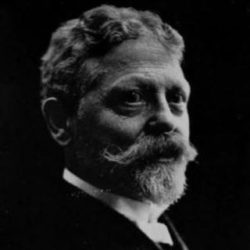
Max Landsberg (1845–1927), born in Berlin, Prussia, was the senior rabbi of the B'rith Kodesh Congregation, Rochester, New York, and one of the best known and most beloved Jewish religious leaders in the United States. He was the eldest son of the rabbi Meyer Landsberg (1810–1870) the rabbi of Hildesheim. After matriculating from high school in 1862, he studied philosophy and oriental philology at the universities of Göttingen and Breslau, completing his studies at the Jewish Theological Seminary of Breslau where he received his rabbinical degree. In 1866, he earned a doctorate from the University of Halle. From 1867, he taught at the seminary in Hanover until 1871 when, on the recommendation of the Jewish reformer Abraham Geiger (1810–1874), he moved to Rochester where he was elected rabbi of the B'rith Kodesh congregation, taking up his appointment in March 1871. In addition to his religious duties, thanks to his scholarship and his interest in philanthropy, he was soon recognized as one of the city's most eminent citizens. By 1894, under his leadership the B'rith Kodesh congregation had grown to more than 250. Langsberg was also active in supporting Rochester's charitable societies, aimed at improving conditions for the poor and needy. Under the United Hebrew Charities of Rochester, these included the Hebrew Benevolent Society, established in 1850, and the Hebrew Ladies' Benevolent Society (1865). He also contributed to social welfare and rights for immigrants, hosting events at the synagogue, including a presentation by the Danish-American social reformer Jacob Riis in 1901. Events were open to the public, in line with Landsberg's efforts to develop collaboration with Christian churches interested in similar objectives. For the JPS 1917 Tanakh, he translated the book of Genesis. He also published the Hymn book for Jewish worship (1880), Ritual for Jewish worship (1885), The position of woman among the Jews (1893), and Outline of the Jewish religion (1899).
Filter resources by Category
Filter resources by Tag
Filter resources by Name
Filter resources by Language
Filter resources by Date Range
Contributed by:
Aharon N. Varady (transcription), Max Landsberg
This is Rabbi Max Landsberg’s public repetition of the weekday amidah as found in his Ritual for Jewish Prayer (1884), pp. 21-28 with adaptations of the traditional blessings found on pp. 52-54.
Contributed by:
Aharon N. Varady (transcription), Max Landsberg
This is Rabbi Max Landsberg’s public repetition of the shaḥarit festival amidah for Sukkot as found in his Ritual for Jewish Prayer (1884), pp. 21-28 with a unique prayer for Sukkot found on pp. 48-49.
Contributed by:
Aharon N. Varady (transcription), Max Landsberg
This is Rabbi Max Landsberg’s public repetition of the shaḥarit festival amidah for Shemini Atseret as found in his Ritual for Jewish Prayer (1884), pp. 21-28 with a unique prayer for Shemini Atseret found on pp. 50-52.
Contributed by:
Aharon N. Varady (transcription), Max Landsberg
This is Rabbi Max Landsberg’s public repetition of the shaḥarit festival amidah for the first day of Pesaḥ as found in his Ritual for Jewish Prayer (1884), pp. 21-28 and pp. 38-41.
Contributed by:
Aharon N. Varady (transcription), Max Landsberg
This is Rabbi Max Landsberg’s public repetition of the shaḥarit festival amidah for the seventh day of Pesaḥ as found in his Ritual for Jewish Prayer (1884), pp. 21-28 and pp. 42-43.
Contributed by:
Aharon N. Varady (transcription), Max Landsberg
This is Rabbi Max Landsberg’s public repetition of the shaḥarit festival amidah for Shavuot as found in his Ritual for Jewish Prayer (1884), pp. 21-28 with a unique prayer for Shavuot found on pp. 44-45.
Contributed by:
Aharon N. Varady (transcription), Max Landsberg
This is Rabbi Max Landsberg’s public repetition of the shaḥarit amidah for a Confirmation Day as found in his Ritual for Jewish Prayer (1884), pp. 21-28 with adaptations of the traditional blessings found on pp. 46-47.
![the Open Siddur Project [logo]](https://opensiddur.org/wp-content/uploads/2018/09/Open-Siddur-Project-Logo-2016.svg)


