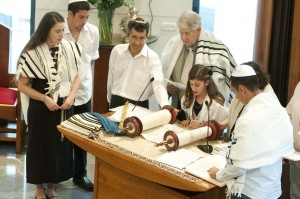
This is an archive of prayers and related resources for those celebrating a bnei mitsvah or other birthday celebration.
⤷ You are here:
🖖︎ Prayers & Praxes —⟶ 🌳︎ Life cycle —⟶ Jewish Life Cycle —⟶ Bnei (Bar/Bat) Mitsvah & Other Birthday Prayers —⟶ Page 2 🡄 (Previous category) :: 📁 Brit Milah & Simḥat Bat 📁 Engagements & Weddings :: (Next Category) 🡆 Bnei (Bar/Bat) Mitsvah & Other Birthday PrayersThis is an archive of prayers and related resources for those celebrating a bnei mitsvah or other birthday celebration. Filter resources by Name Felix Adler | Grace Aguilar | Arnaud Aron | Benjamin Artom | Pereẓ (Peter) Beer | Marcus Heinrich Bresslau | Central Conference of American Rabbis [CCAR] | Aryeh Cohen | Julia Matilda Waley Cohen | Angie Irma Cohon | Frederick de Sola Mendes | Miriam del Banco | Jonas Ennery | Refoyl Finkl (translation) | Shem Tov Gaguine | Esteban Gottfried | Mosheh Halperin | חיים היימס-עזרא | Mordecai Kaplan | Abe Katz (translation) | Max Landsberg | Max Lilienthal | Isaac Gantwerk Mayer | Isaac Gantwerk Mayer (translation) | Moritz Mayer | Lilian Helen Montagu | Isaac Montagu | Jessie Ethel Sampter | Benjamin Szold | Unknown | Aharon N. Varady (transcription) | Aharon N. Varady (translation) Filter resources by Tag acrostic | ageing | alienation | Alphabetic Acrostic | עמידה amidah | Angelic Protection | appreciation | אשר יצר Asher Yatsar | Bar Mitsvah | בת מצוה Bat Mitsvah | Before the Aliyot | Beit Tefillah Yisraeli | birthday prayers | blessings | בצלם אלהים btselem Elohim | children's prayers | civil declarations and charters | confirmation | Decalogue | declarations | English poetry | English vernacular prayer | exhortation | French Jewry | French vernacular prayer | German vernacular prayer | Gratitude | hand laying | hymns | Jewish identity | Jewish particularism | Jewish Women's Prayers | קרובות ḳerovot | קריאת התורה ḳriyat hatorah | Maimonides | Masorti | memento mori | מי שברך mi sheberakh | Moshe ben Maimon | מוסר mussar | Needing Proofreading | Needing Vocalization | Old Age | paraliturgical modim | parents | Parents blessing children | performing mitsvot | פיוטים piyyuṭim | Prayers as poems | prayers concerning children | prayers for adolescents | prayers on behalf of parents | prayers of health care workers | Prayers of Jewish Educators | Prayers of Primary Caregivers | Public Amidah | rhyming translation | שהחינו shehiyanu | שבעתא shiv'ata | Spanish-Portuguese | Teacher | תחינות teḥinot | teḥinot in English | Teḥinot in German | thanksgiving | תוכחות tokheḥot | וידוי vidui | West Central Girls' Club | Western Sefaradim | עדות witnessing | ישראל Yisrael | 17th century C.E. | 19th century C.E. | 20th century C.E. | 21st century C.E. | 54th century A.M. | 56th century A.M. | 57th century A.M. | 58th century A.M. Filter resources by Category Addenda | During the Aliyot | Weekday Amidah | Conversion | Erev Pesaḥ | Learning, Study, and School | Old Age | Rosh haShanah (l’Maaseh Bereshit) | Shavuot | Well-being, health, and caregiving Filter resources by Language Filter resources by Date Range Sorted Chronologically (old to new). Sort most recent first? This is Rabbi Max Landsberg’s public repetition of the shaḥarit amidah for a Confirmation Day as found in his Ritual for Jewish Prayer (1884), pp. 21-28 with adaptations of the traditional blessings found on pp. 46-47. Categories: Tags: Contributor(s): “A Child’s Prayer on its Parent’s Birthday” was written by Frederick de Sola Mendes and published in the anthology, The Jewish Home Prayer-Book (1887), pages 130-131. “A Child’s Prayer on its Birthday” was written by Frederick de Sola Mendes and published in the anthology, The Jewish Home Prayer-Book (1887), page 130. “Birthday Prayer” was written by Lilian Helen Montagu and published in Prayers for Jewish Working Girls (1895), pp. 29-30. “Prayer of Thanksgiving” was written by Lilian Helen Montagu and published in Prayers for Jewish Working Girls (1895), pp. 6-7. This prayer reads to me as possibly intended to be used as a prayer of transition, before the tradition of the bat mitsvah was universally adopted, at a time when a young woman might be old enough to begin contemplating their future, their marriage prospects, and their general “usefulness” — especially in regards to their future work — the overarching theme of this collection of prayers. This affirmation in particular stands out to me as radically important for Lilian Montagu and other young suffragettes to express in 1895: “Lord, whether in the future I marry or whether I remain single, I shall be able to lead a useful, happy life” and “Lord, I thank Thee for my womanhood!” Categories: Tags: 19th century C.E., 57th century A.M., English vernacular prayer, Gratitude, Jewish Women's Prayers, paraliturgical modim, תחינות teḥinot, teḥinot in English, thanksgiving, West Central Girls' Club Contributor(s): This “Birthday Prayer” is found in Julia M. Cohen’s The children’s Psalm-book, a selection of Psalms with explanatory comments, together with a prayer-book for home use in Jewish families (1907), pp. 304-305. This translation of the blessing sheheḥiyanu was written by Jessie Ethel Sampter and published under the title “Blessing for Rosh-Hashanah” in her Around the Year in Rhymes for the Jewish Child (1920), p. 11. This is a restatement of the Decalogue offered as life wisdom by Rabbi Dr. Mordecai Kaplan for his daughters, sometime in the 1920s, possibly as early as 1922 at the Bat Mitsvah of his oldest daughter Judith. The document was found by Mel Scult and shared by him from his Mordecai Kaplan Discussion Group on Facebook. “Hymn for Shaḇuoth (Father, See Thy Children)” is based on “Confirmation (Father, see thy suppliant children)” an original hymn by Felix Adler published in Hymns, for Divine Service in the Temple Emanu-El (1871), hymn 34, p. 68. The last four lines of the hymn have been amended and replaced with “Till our lives shall bud and blossom…” by Angie Irma Cohon, for use on Shavuot. This version was published in her תפלת ישראל (Tefilat Yisrael) A Brief Jewish Ritual (Women of Miẓpah 1921), p. 19. Categories: Tags: Contributor(s): “Israel’s Unity” is the twenty-eighth prayer found in ברכה ותהלה Blessing and Praise: A Book of Meditations and Prayers for Individual and Home Devotion (CCAR 1923), pp. 96-98. Categories: Tags: 20th century C.E., 57th century A.M., alienation, English vernacular prayer, exhortation, Jewish identity, Jewish particularism, teḥinot in English, תוכחות tokheḥot Contributor(s): “Shaḇuoth—The Feast of Weeks” is the forty-first prayer found in ברכה ותהלה Blessing and Praise: A Book of Meditations and Prayers for Individual and Home Devotion (CCAR 1923), pp. 135-138. Categories: Tags: 20th century C.E., 57th century A.M., confirmation, English vernacular prayer, exhortation, performing mitsvot, prayers on behalf of parents, teḥinot in English, עדות witnessing Contributor(s): The poem “Confirmation” by Miriam del Banco (1858-1931) was included in her posthumously published anthology, Poetry and Prose (1932), p. 80-81. “A Thanksgiving in Commemoration of Moses Maimonides” with its accompanying Hashkabah is found in the Service of Praise and Thanksgiving to Commemorate the 800th Anniversary of the Birth of Moses Maimonides prepared by Bevis Marks Synagogue in London on 27 May 1935. Categories: Tags: Contributor(s): “Prayer in behalf of one celebrating a birthday,” by Rabbi Mordecai Menaḥem Kaplan can be found on p. 494-497 of his The Sabbath Prayer Book (New York: The Jewish Reconstructionist Foundation, 1945) “[Prayer for a] Birthday Celebration” is found in the “Family Worship” section of the Union Home Prayer Book (CCAR 1951), page 31. I wrote this brachah on the occasion of my son Oryah’s bar mitsvah. The Aramaic/Hebrew and the translation are mine. My partner and I recited the blessing after my son was called up to the Torah. The brachah replaces the ברוך שפטרנו which is recited in some communities. This blessing (which is basically self-explanatory) expresses gratitude for Divine favor leading to this moment and a prayer for Heavenly guidance for my son’s continued path. Though the translation is gender neutral in relation to God, the Hebrew/Aramaic is gendered masculine. This is my practice with regards to my children. I bless my daughter with feminine God language and my son with masculine God language. The blessing can be grammatically adapted for a bat mitsvah. A statement by the Bat Mitsvah after her first aliyah. שבחי המשפחה לבת המצווה | A Prayer in Honor of a Bat mitsvah from her Family, by Dr. Chaim Hames-EzraA prayer for a ritual of blessing of a bat mitsvah by her family. This is a “Blessing for the human creation” composed by Rabbi Esteban Gottfried for a mi sheberakh delivered after the Torah reading of twin siblings celebrating their bar and bat mitsvah. Both children came into this world through medical intervention, egg donation, and surrogate pregnancy. “It was a really moving ceremony,” said Rabbi Gottfried, “it is very rare that the parents are in touch with the egg donor and pregnancy surrogate (from the US and Ukraine) thirteen years later, and they all celebrate together….After their ascent to the Torah, I asked the parents together with the donor and the surrogate to take the stage and greet them. I share here (with their approval) the blessing of the “Human Creation.” A Mi SheBerakh for the 70th anniversary of the bar mitzvah ceremony, referred to by some as a “Ḥanukat Bar Mitzvah” or “second bar mitsvah.” Written for the ḥanukat bar mitzvah of the author’s grandfather, 30 August 2015. Categories: Tags: Contributor(s):
Stable Link:
https://opensiddur.org/index.php?cat=1192
Associated Image: (This image is set to automatically show as the "featured image" in shared links on social media.)
Terms of Use:
Be a mentsch (a conscientious, considerate person) and adhere to the following guidelines:
Additional Notes:
Support this work:
The Open Siddur Project is a volunteer-driven, non-profit, non-commercial, non-denominational, non-prescriptive, gratis & libre Open Access archive of contemplative praxes, liturgical readings, and Jewish prayer literature (historic and contemporary, familiar and obscure) composed in every era, region, and language Jews have ever prayed. Our goal is to provide a platform for sharing open-source resources, tools, and content for individuals and communities crafting their own prayerbook (siddur). Through this we hope to empower personal autonomy, preserve customs, and foster creativity in religious culture. ויהי נעם אדני אלהינו עלינו ומעשה ידינו כוננה עלינו ומעשה ידינו כוננהו׃ (תהלים צ:יז) · "May the pleasantness of אדֹני our elo’ah be upon us; may our handiwork be established for us — our handiwork, may it be established." (Psalms 90:17) | ||
Sign up for a summary of new resources shared by contributors each week
![]() ![]() |
