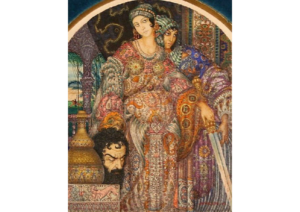
This is an archive of special readings prepared for the חג הבנות | Ḥag haBanot (عيد البنات | עיד אלבנאת | Eid el Benat), for the days on which Rosh Ḥodesh Tevet coincide with Ḥanukkah. As Dr. Lori Lefkowitz has written, "On this New Moon...girls are given gifts, sometimes jewelry that would be their inheritance, and special blessings. It is customary to read the story of Judith, and yes, to eat salty cheeses. And one custom that I especially like, girls who were quarreling used the occasion of the festival to kiss and make up." Click here to contribute a special reading, prayer, or song that you have prepared for the Ḥag haBanot. Filter resources by Name Filter resources by Tag Filter resources by Category Filter resources by Language Filter resources by Date Range
“Odekha ki anafta bi (I give thanks to you although you were angry with me) was composed by Joseph ben Solomon of Carcassonne, who is dated to the first half of the eleventh century. This elegant and abstruse poem tells an epic tale of the Jews’ resistance to the decrees of Antiochus IV and includes accounts of both the Hasmonean bride and Judith. It bears a considerable resemblance to texts 4 and 12 of the Hanukkah midrashim (find Grintz, Sefer Yehudit, pp. 205, 207–08) and this is evidence for the circulation of the joint Hasmonean daughter-Judith tales in the eleventh century, even if the surviving manuscripts of these stories are from a later date.” (Deborah Levine Gera, “The Jewish Textual Traditions” in The Sword of Judith: Judith Studies Across the Disciplines (2010).) Categories: Tags: Contributor(s): The text of Ma’aseh Yehudit, the story of Judith, as found in Sefer Ḥemdat Yamim, a mystical compilation of customs and tiqqunim first published in İzmir in around 1731. (This text is also found as “Maaseh Yehudit, Version 2” in Judah David Eisenstein’s monumental Otzar Midrashim compilation.) Sefer Ḥemdat Yamim is a unique work, likely compiled by a Sabbatean but largely based on earlier pre-Sabbatean mystical sources, and because of this any specific text in it is quite difficult to date. This specific version of the story of Judith shows substantial influence from the Septuagintal text not found in earlier Jewish variants, giving a likely terminus post quem of several generations after the Inquisition when Spanish benei anusim brought their knowledge of the Vulgate’s apocrypha with them to Judaism. Even so, it is very clearly a fundamentally Jewish work. It is appropriate to recite on Yom haBanot (1 Tevet) or any time throughout Ḥanukkah, perhaps with Esther cantillation. Categories: Tags: Contributor(s): |
![the Open Siddur Project [logo]](https://opensiddur.org/wp-content/uploads/2018/09/Open-Siddur-Project-Logo-2016.svg)