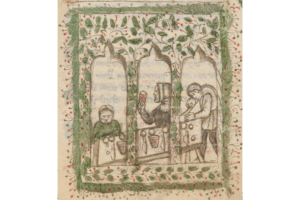
This is an archive of prayers, prayer-poems, and songs for the pilgrimage festival of סֻכּוֹת Sukkot. (In some older English translations, Sukkot is referred to as the Festival of "Tabernacles"). The seven day festival culminates with Hoshanah Rabba, the last of the three high holy days of atonement preceding Shemini Atseret upon which the Tefilat Geshem (prayer for rain) is offered for the fertility of all life on Earth and the resulting health of all peoples. The origin of Ḥanukkah underscores the significance of these festivals. During the Seleucid Greek occupation of Jerusalem in the 160s BCE, Sukkot and Shemini Atseret could not properly be celebrated in the second Temple. As a result, when the Temple was retaken by the Maccabees after the rainy season had already begun, the festival of Ḥanukkah was born with many of Sukkot and Shemini Atseret's rain and temple-offering oriented symbolism transformed to that of light and the temple illumination. Click here to contribute a prayer or a transcription or translation of a historic prayer. Filter resources by Name Filter resources by Tag Filter resources by Category Filter resources by Language Filter resources by Date Range
A supplemental Hoshanot liturgy for Sukkot confessing a selection of humanity’s crimes against creation. Categories: Tags: Contributor(s): The essential idea of the liturgy of Ushpizin is to invoke the energies of the seven lower Sefirot in the proper order, so that Shefa, blessing and sustenance, can be drawn down into the world. This is the essence of Kabbalistic liturgy, and a liturgy of the imahot would only make sense if it were to follow that pattern. That means we have the playfully serious task of finding a stable order for the imahot where no clear order exists. Categories: Tags: 21st century C.E., 58th century A.M., Ancestors, archetypes, Avot and Imahot, ecoḥasid, in the merit of our ancestors, North America, Prayers inside sukkot, קבלה ḳabbalah, ספירות sefirot, spirits, אושפיזתא Ushpizata, אושפיזין ushpizin Contributor(s): Please God
Let me light
More than flame tonight. More than wax and wick
and sliver stick of wood.
More than shallow stream of words
recited from a pocket book. Categories: Tags: 21st century C.E., 58th century A.M., candle lighting, English poetry, English vernacular prayer, entering, fire, כוונות kavvanot, kindling, Light, potential, Prayers as poems, welcoming Contributor(s): “In the Sukkah At Least, It’s a Wonderful World” by Len Fellman was written for Sukkot in 2015. Categories: Tags: Contributor(s): A supplemental hoshana (prayer for salvation) for healing and consolation for the sake of true love, needed blessings, rainfall in a timely fashion, paths and their repair, mountains and their crossing, goals and objectives, lasting memories, good dreams, cosmic goodness, etc. Categories: Tags: Contributor(s): There is a famous Seliḥot prayer where each of its lines has this structure: “May He who answered ___________, may he answer us.” The blank refers to assorted Biblical figures who faced great challenges, ranging from Avraham the Patriarch to Ezra the Scribe. The traditional list is also VERY male-focused, with the standard text only listing Esther from all the great Biblical women. This is a shame, and many have tried to remedy this. I have found myself under the opinion that all these remedies have a fault – they attempt to combine the original text with the new text. This means either the original text is shortened, or the full text is far too long. As well, the structure is very male-oriented as well, appealing to God’s male side and only using grammatically male language. Categories: Tags: 21st century C.E., 58th century A.M., Biblical Women, Divine Presence, אמהות Imahot, in the merit of our ancestors, מי שענה Mi She’anah, North America, סליחות səliḥot, שכינה Shekhinah, תשרי זמן Tishrei Zman, אושפיזתא Ushpizata Contributor(s): The Opening Prayer given in the U.S. House of Representatives on 24 September 2018. Categories: Tags: 115th Congress, 21st century C.E., 58th century A.M., English vernacular prayer, hakhnasat orḥim, hospitality, U.S. House of Representatives, Prayers of Guest Chaplains, תחינות teḥinot, United States Immigration Policy, welcoming Contributor(s): The words of Greta Thunberg adapted for a prayer for intervention in the anthropogenic climate crisis, for a Honshana ritual for Sukkot. Categories: Tags: Contributor(s): A litany of hoshanot for use in a ritual prayer circle march on the festival of Sukkot. Categories: Tags: Contributor(s): A litany of hoshanot for use in a ritual prayer circle march on the festival of Sukkot. Categories: Tags: Contributor(s): The ceremony of welcoming ushpizin originated in the Jewish mystical tradition of Qabbala, for which the ushipizin represented the divine emanations called “sefiroth”, in the context of the sukka as a representation of Ultimate Redemption. Because of this mystical association, the ceremony was rejected by some communities (such as Spanish and Portuguese Jews) and individuals (such as diehard rationalists). Without applying mystical implications, however, we can see this ritual as a symbol of how we bring into our lives diverse aspects of Jewish history and tradition as we navigate our spiritual journeys. Categories: Tags: Contributor(s): This prayer by Rabbi Seidenberg was shared via his English newsletter and social media in the days preceding Sukkot 2024. Categories: Tags: Contributor(s): A Hoshana for Sukkot 5785 with a forward-looking perspective because Sukkot is a time for building, even if that building is fragile. It was written for the weekday minyan at Kehillat Hod veHadar. Categories: Tags: Contributor(s): |
![the Open Siddur Project [logo]](https://opensiddur.org/wp-content/uploads/2018/09/Open-Siddur-Project-Logo-2016.svg)