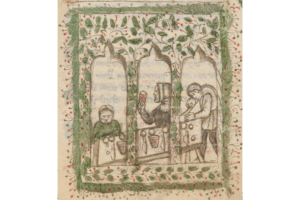
This is an archive of prayers, prayer-poems, and songs for the pilgrimage festival of סֻכּוֹת Sukkot. (In some older English translations, Sukkot is referred to as the Festival of "Tabernacles"). The seven day festival culminates with Hoshanah Rabba, the last of the three high holy days of atonement preceding Shemini Atseret upon which the Tefilat Geshem (prayer for rain) is offered for the fertility of all life on Earth and the resulting health of all peoples. The origin of Ḥanukkah underscores the significance of these festivals. During the Seleucid Greek occupation of Jerusalem in the 160s BCE, Sukkot and Shemini Atseret could not properly be celebrated in the second Temple. As a result, when the Temple was retaken by the Maccabees after the rainy season had already begun, the festival of Ḥanukkah was born with many of Sukkot and Shemini Atseret's rain and temple-offering oriented symbolism transformed to that of light and the temple illumination. Click here to contribute a prayer or a transcription or translation of a historic prayer. Filter resources by Name Filter resources by Tag Filter resources by Category Filter resources by Language Filter resources by Date Range
Resources filtered by COLLABORATOR: “Aharon N. Varady (transcription)” (clear filter)This is the piyyut, “Aamir Otekha Selah” by Elazar ben Qallir for Sukkot, as translated into rhyming English verse by Alice Montefiore Lucas, first published in her anthology of versified translations Songs of Zion by Hebrew Singers of Mediæval Times (1894). Her translation was later set opposite Qallir’s Hebrew text in Maḥzor Avodat Ohel Moed: Avodat Ḥag haSukkot (ed. Arthur Davis & Herbert Adler, 1908). Categories: Tags: Contributor(s): This is the piyyut “Az Haytah Ḥanayat Sukō (Of yore, abode His dwelling place,)” a qerovah piyyut by Elazar Kalir for the first day of Sukkot, published in Adler and Davis’s Maḥzor for Sukkot, Avodat Ḥag ha-Sukkot (1908), pp. 212. Categories: Tags: Contributor(s): This is the piyyut “Az K’einei Avadim (As slaves, with eyes beseeching,…)” by an unknown paytan for the seventh circuit of the Hoshana Rabba service (on the seventh and final day of Sukkot), published in Adler and Davis’s Maḥzor for Sukkot, Avodat Ḥag ha-Sukkot (1908), pp. 183. Categories: Tags: Contributor(s): This is the piyyut “Kehoshata Elim (Savior of mighty ones…)” by Eleazar Kalir for the hoshanot on the second day of Sukkot, published in Adler and Davis’s Maḥzor for Sukkot, Avodat Ḥag ha-Sukkot (1908), pp. 144-145. Categories: Tags: Contributor(s): A prayer for Sukkot linking the theme of home building and receiving Torah with a warning not to eat animals and to extend ones compassion to all creatures. Categories: Tags: Contributor(s): Categories: Tags: Contributor(s): Categories: Tags: Contributor(s): Categories: Tags: Contributor(s): As part of our ongoing project creating a new digital edition of Fanny Neuda’s collection of tkhines in German, Stunden Der Andacht (1855), we are setting her prayers (for the first time ever) side by side with that of her work’s first English translation. Categories: Tags: Contributor(s): Herr des Weltalls, reich geschmückt mit deinen Gaben und Segnungen hast du die Natur. Das Thal mit seinem üppigen Grün, der Berg mit seinem Kranz von Wäldern, das Gefilde mit seiner lachenden Frucht ist ein Erzeugnis; deiner Gnade, zum Segen deiner Menschenkinder, zur Nahrung ihres Leibes, zur Stillung ihrer Bedürfnisse, zur Ergötzung ihres Auges, zum Balsam ihrer Wunden; und kein Blättchen ist so klein, kein Grashalm so niedrig in dem weiten Reiche der Natur, daß es nicht wohlthuende heilsame Kräfte für uns enthielte. Categories: Tags: Contributor(s): This is Fanny Neuda’s “Prayer for the final days of Sukkot,” faithfully transcribed and proofread with the help of German Wikisource contributors from Fanny Neuda’s Stunden Der Andacht (1855), p. 66. Categories: Tags: Contributor(s): A prayer for a woman celebrating the first yontef of Sukkot. Categories: Tags: Contributor(s): This is Rabbi Max Landsberg’s public repetition of the shaḥarit festival amidah for Sukkot as found in his Ritual for Jewish Prayer (1884), pp. 21-28 with a unique prayer for Sukkot found on pp. 48-49. Categories: Tags: Contributor(s): This rhyming paraphrase of the blessing before waving the lulav on Sukkot was written by Jessie Ethel Sampter and published in her Around the Year in Rhymes for the Jewish Child (1920), p. 17. Categories: Tags: Contributor(s): Categories: Tags: Contributor(s): Categories: Tags: Contributor(s): Categories: Tags: Contributor(s): Categories: Tags: Contributor(s): |
![the Open Siddur Project [logo]](https://opensiddur.org/wp-content/uploads/2018/09/Open-Siddur-Project-Logo-2016.svg)