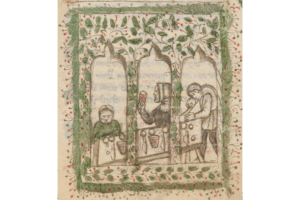
This is an archive of prayers, prayer-poems, and songs for the pilgrimage festival of סֻכּוֹת Sukkot. (In some older English translations, Sukkot is referred to as the Festival of "Tabernacles"). The seven day festival culminates with Hoshanah Rabba, the last of the three high holy days of atonement preceding Shemini Atseret upon which the Tefilat Geshem (prayer for rain) is offered for the fertility of all life on Earth and the resulting health of all peoples. The origin of Ḥanukkah underscores the significance of these festivals. During the Seleucid Greek occupation of Jerusalem in the 160s BCE, Sukkot and Shemini Atseret could not properly be celebrated in the second Temple. As a result, when the Temple was retaken by the Maccabees after the rainy season had already begun, the festival of Ḥanukkah was born with many of Sukkot and Shemini Atseret's rain and temple-offering oriented symbolism transformed to that of light and the temple illumination. Click here to contribute a prayer or a transcription or translation of a historic prayer. Filter resources by Name Filter resources by Tag Filter resources by Category Filter resources by Language Filter resources by Date Range
Resources filtered by COLLABORATOR: “Yehoshua Heshil Miro” (clear filter)“[Für den ersten Tag des Laubhüttenfestes (no.2]” was translated/adapted by Yehoshua Heshil Miro and published in his anthology of teḥinot, בית יעקב (Beit Yaaqov) Allgemeines Gebetbuch für gebildete Frauen mosaicher Religion. It first appears in the 1829 edition, תחנות Teḥinot ein Gebetbuch für gebildete Frauenzimmer mosaicher Religion as teḥinah №49 on pp. 70-72. In the 1835 edition, it appears as teḥinah №51 pp. 88-90. In the 1842 edition, it appears as teḥinah №53 on pp. 93-95. Categories: Tags: Contributor(s): “Am siebenten Tage des Laubhüttenfestes. (Hoschana Raba)” was translated/adapted by Yehoshua Heshil Miro and published in his anthology of teḥinot, בית יעקב (Beit Yaaqov) Allgemeines Gebetbuch für gebildete Frauen mosaicher Religion. It first appears in the 1829 edition, תחנות Teḥinot ein Gebetbuch für gebildete Frauenzimmer mosaicher Religion as teḥinah №50 on pp. 72-73. In the 1835 edition, it appears (misnumbered) as teḥinah №51 pp. 90-91. In the 1842 edition, it appears as teḥinah №54 on pp. 95-96. Categories: Tags: Contributor(s): “Vor dem Etrog-Segen” was translated/adapted by Yehoshua Heshil Miro and published in his anthology of teḥinot, בית יעקב (Beit Yaaqov) Allgemeines Gebetbuch für gebildete Frauen mosaicher Religion. It first appears in the 1829 edition, תחנות Teḥinot ein Gebetbuch für gebildete Frauenzimmer mosaicher Religion as teḥinah №47 on pp. 67-68. In the 1835 edition, it appears as teḥinah №49 pp. 85-86. In the 1842 edition, it appears as teḥinah №51 on p. 90. Categories: Tags: Contributor(s): “Für den ersten Tag des Laubhüttenfestes” was translated/adapted by Yehoshua Heshil Miro and published in his anthology of teḥinot, בית יעקב (Beit Yaaqov) Allgemeines Gebetbuch für gebildete Frauen mosaicher Religion. It first appears in the 1829 edition, תחנות Teḥinot ein Gebetbuch für gebildete Frauenzimmer mosaicher Religion as teḥinah №48 on pp. 68-70. In the 1835 edition, it appears as teḥinah №50 pp. 86-88. In the 1842 edition, it appears as teḥinah №52 on pp. 91-93. Categories: Tags: Contributor(s): “An den Hauptfesten, wenn man Behufs der üblichen Vorlesungen die Gesetzrolle aus der heiligen Lade nimmt” was translated/adapted by Yehoshua Heshil Miro and published in his anthology of teḥinot, בית יעקב (Beit Yaaqov) Allgemeines Gebetbuch für gebildete Frauen mosaischer Religion. It first appears in the 1829 edition, תחנות Teḥinot ein Gebetbuch für gebildete Frauenzimmer mosaischer Religion as teḥinah №18 on pp. 22-23. In the 1835 edition, it appears as teḥinah №18 on pp. 26-27. In the 1842 edition, it appears as teḥinah №20 on pp. 29-31. Categories: Tags: Contributor(s): Categories: Tags: Contributor(s): Categories: Tags: Contributor(s): |
![the Open Siddur Project [logo]](https://opensiddur.org/wp-content/uploads/2018/09/Open-Siddur-Project-Logo-2016.svg)