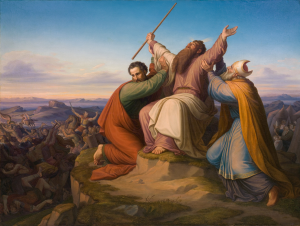
This is an archive of Torah and Haftarah readings for Parashat b'Shalaḥ (Exodus 13:17-17:16), the fourth parashah in Sefer Shemot according to the annual Torah reading cycle. The haftarah reading for Parashat b'Shalaḥ is Judges 4:4-5:31. Parashat b'Shalaḥ is preceded by parashat Parashat Bo (Exodus 10:1-13:16). Parashat Yitro (Exodus 18:1-20:22) follows it. Click here to contribute a novel translation of a Torah or Haftarah reading you have prepared for Parashat b'Shalaḥ. Filter resources by Name Filter resources by Tag Filter resources by Category Filter resources by Language Filter resources by Date Range According to Rabbinic tradition, the 21st of Nissan is the day in the Jewish calendar on which Pharaoh’s army was drowned in the Sea of Reeds, and the redeemed children of Yisrael sang the Song of the Sea, the (Shirat Hayam, Exodus 15:1-19). The song, as included in the the morning prayers, comprises one of the most ancient text in Jewish liturgy. The 21st of Nissan corresponds to the 7th day of Passover, and the recitation of the Shirat HaYam is part of the daily Torah Reading. Rabbi Hillel Ḥayim Yisraeli-Lavery shares a performance of a melody he learned for the Shirat Hayam from צוף דבש Tzuf Devash, a Moroccan synagogue in the Old City of Jerusalem. If there is something about this tune that strikes one as particularly celebratory, it might be because the relationship between G!d and the Jewish people is traditionally described as a marriage consummated with the Covenant at Mt. Sinai. The passage of Bnei Yisrael through the Sea of Reeds towards Mt. Sinai thus begins a bridal march commencing in the theophany at Mt. Sinai, 42 days later. Categories: Tags: Contributor(s): This is the Song of Miriam from a parabiblical (or pseudo-biblical) attestation in 4Q365, as reconstructed by scholars based on the work of largely based on the work of Dr. Ariel Feldman, and with addition lacunae filled in by Issac Gantwerk Mayer. Isaac also vocalized, cantillated, and translated the test according to Masoretic norms, and provided a rendering of the text styled according to the Shirat ha-Yam as reproduced by scribes in the Masoretic tradition. Categories: Tags: Contributor(s): This piyyuṭ, bearing the acrostic signature “Samuel,” is traditionally recited in the communities of Babylonia and India as a petiḥa, or opening poem, before the Song of the Sea. It is also sung on Shabbat Shira, the Sabbath where we read the Song of the Sea in public. This translation is an attempt to preserve the original meaning as well as the rhyme scheme and poetic form. Categories: Tags: Contributor(s): Ashira k-Shirat Moshe is a brief piyyut of uncertain origin, recited in Moroccan Jewish practice as an introduction to the Song of the Sea at the end of Zemirot on Shabbat Shirah and the seventh day of Pesaḥ. It lists seven Biblical songs — those of Moses, Miriam, Joshua, Deborah, Hannah, David, and Solomon — and concludes with an eighth song, the song that Israel will sing at the the future redemption. Categories: Tags: Contributor(s): Originally written by Yehuda haLevi for the seventh day of Pesaḥ, Yom le-Yabasha — a celebration of the crossing of the Sea of Reeds and the establishment of the covenant as signified by the circumcision and tsitsit — it quickly became a beloved piyyut on that occasion and more. Categories: Tags: Contributor(s): A medieval manuscript illustration of the aggadah that the Yam Suf was split in 12 discrete channels, one for each tribe, as reflected above by a 12-color rainbow Categories: Tags: Contributor(s): This is a pizmon for Shabbat Shirah (Parashat B’Shalaḥ) by an unknown author. The text is as transcribed from the pizmonim included in the siddur משמרת הקדש: קול שומר שבת Mishmeret haQodesh: Qol Shomer Shabbat (Pisa 1821), p. 117. Categories: Tags: Contributor(s): This pizmon, signed with the name Moshe but of otherwise unclear attribution, is recited in the Sephardic communities of Rhodes and Istanbul (and nowadays in Seattle) before the open ark on Shabbat Shirah and the seventh day of Pesaḥ. The main Hebrew text of the first and last two stanzas are as found in the Seattle Sephardic community’s 2002 Siddur Zehut Yosef (as well as the Gözlem Kitap press in Istanbul’s 2011 Şaloş Regalim), with footnotes marking differences in the Shirei Yisrael B’Erets HaḲedem (published in Istanbul in 1921) and the Yeshiva University Library diwan of Baruch Moshe Moreno, written by hand in the monastery neighborhood of Tiberias in 1867 (YU MS. 1126). In between are three additional non-rhyming stanzas found in substantially different form in the other two sources but not recited in modern Sephardic communities. Categories: Tags: Contributor(s): This pizmon, signed with the name Moshe but of otherwise unclear attribution, is recited in the Sephardic communities of Rhodes and Istanbul (and nowadays in Seattle) before the open ark on Shabbat Shirah and the seventh day of Pesaḥ. The main Hebrew text of the first and last two stanzas are as found in the Seattle Sephardic community’s 2002 Siddur Zehut Yosef (as well as the Gözlem Kitap press in Istanbul’s 2011 Şaloş Regalim), with footnotes marking differences in the Shirei Yisrael B’Erets HaḲedem (published in Istanbul in 1921) and the Yeshiva University Library diwan of Baruch Moshe Moreno, written by hand in the monastery neighborhood of Tiberias in 1867 (YU MS. 1126). In between are three additional non-rhyming stanzas found in substantially different form in the other two sources but not recited in modern Sephardic communities. Categories: Tags: Contributor(s): “Lord, do Thou guide me” by Alice Montefiore Lucas was written for “Sabbath—ⅩⅥ,” (i.e., Shabbat parashat b’Shalaḥ) and first published in her collection of prayers, The Jewish Year (1898), p. 34. Categories: Tags: Contributor(s): “The Song of Miriam” by Rabbi Ruth Sohn was first published as “I Shall Sing to the Lord a New Song,” in Kol Haneshamah: Shabbat Vehagim, Reconstructionist Prayerbook, 1989, 1995 Second Edition. Reconstructionist Press, pp. 768-769. (This poem was also published in several haggadot and other books and set to music by several composers in the U.S. and Israel.) Rabbi Sohn wrote the poem in 1981 as a rabbinical student after immersing herself in the Torah verses and the traditional midrashim about Miriam, and after writing a longer modern midrash about Miriam. Part of this modern midrash was published as “Journeys,” in All the Women Followed Her, ed. Rebecca Schwartz (Rikudei Miriam Press, 2001). Categories: Tags: 20th century C.E., 58th century A.M., אז ישיר Az Yashir, English vernacular prayer, Jewish Women's Prayers, Miriam, Opening Prayers, Openers, Prayers as poems, תפילות קודם התפילה Prayers before Praying, Prayers for Praying Contributor(s): These are the lyrics of the song, Miryam haNevi’ah, written by rabbis Leila Gal Berner and Arthur Waskow (with Hebrew by Leila Gal Berner) as found published in My People’s Prayer Book, vol. 7: Shabbat at Home, (ed. L. Hoffman, 1997), section 3, p. 189. The English lyrics are from an article published several years earlier — “Memories of a Jewish Lesbian Evening” by Roger McDougle appearing in Bridges (vol. 4:1, Winter/Spring 1994), on the top of page 58. No specific date is given for the havdalah program described in the article, alas. If you know the earliest reference for the publication or use of Miryam haNevi’ah, please contact us. Categories: Tags: Contributor(s): This piece emerged in February 2023 upon realizing that instead of reading ים סוף as Yam Suf (generally understood at the Sea of Reeds), it could be read as Yam Sof: Sea of End[ing]. It was apparent to me that we may have approached this sea (escaping from slavery) thinking that it would be the end of us. It was not. But it was the end of *something*. Categories: Tags: Contributor(s): “Shirat Miriam and Devorah / Uri, Uri” (Song of Miriam, Song of Deborah / Rise up, Rise Up) was first published in 2024, as the second of four piyyutim published through the Diwan Ashira Project by Ephraim Kahn. Categories: Tags: 2023-2025 Israel–Hamas war, 21st century C.E., 58th century A.M., Devorah, Miriam, פיוטים piyyuṭim, רשויות reshuyot, פרשת בשלח parashat B'shalaḥ, שבת שירה shabbat shirah, שירת הים Shirat haYam, זמירות zemirot Contributor(s): |
![the Open Siddur Project [logo]](https://opensiddur.org/wp-content/uploads/2018/09/Open-Siddur-Project-Logo-2016.svg)