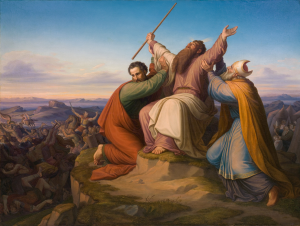
This is an archive of Torah and Haftarah readings for Parashat b'Shalaḥ (Exodus 13:17-17:16), the fourth parashah in Sefer Shemot according to the annual Torah reading cycle. The haftarah reading for Parashat b'Shalaḥ is Judges 4:4-5:31. Parashat b'Shalaḥ is preceded by parashat Parashat Bo (Exodus 10:1-13:16). Parashat Yitro (Exodus 18:1-20:22) follows it. Click here to contribute a novel translation of a Torah or Haftarah reading you have prepared for Parashat b'Shalaḥ. Filter resources by Name Filter resources by Tag Filter resources by Category Filter resources by Language Filter resources by Date Range This is the Song of Miriam from a parabiblical (or pseudo-biblical) attestation in 4Q365, as reconstructed by scholars based on the work of largely based on the work of Dr. Ariel Feldman, and with addition lacunae filled in by Issac Gantwerk Mayer. Isaac also vocalized, cantillated, and translated the test according to Masoretic norms, and provided a rendering of the text styled according to the Shirat ha-Yam as reproduced by scribes in the Masoretic tradition. Categories: Tags: Contributor(s): Ashira k-Shirat Moshe is a brief piyyut of uncertain origin, recited in Moroccan Jewish practice as an introduction to the Song of the Sea at the end of Zemirot on Shabbat Shirah and the seventh day of Pesaḥ. It lists seven Biblical songs — those of Moses, Miriam, Joshua, Deborah, Hannah, David, and Solomon — and concludes with an eighth song, the song that Israel will sing at the the future redemption. Categories: Tags: Contributor(s): “The Song of Miriam” by Rabbi Ruth Sohn was first published as “I Shall Sing to the Lord a New Song,” in Kol Haneshamah: Shabbat Vehagim, Reconstructionist Prayerbook, 1989, 1995 Second Edition. Reconstructionist Press, pp. 768-769. (This poem was also published in several haggadot and other books and set to music by several composers in the U.S. and Israel.) Rabbi Sohn wrote the poem in 1981 as a rabbinical student after immersing herself in the Torah verses and the traditional midrashim about Miriam, and after writing a longer modern midrash about Miriam. Part of this modern midrash was published as “Journeys,” in All the Women Followed Her, ed. Rebecca Schwartz (Rikudei Miriam Press, 2001). Categories: Tags: 20th century C.E., 58th century A.M., אז ישיר Az Yashir, English vernacular prayer, Jewish Women's Prayers, Miriam, Opening Prayers, Openers, Prayers as poems, תפילות קודם התפילה Prayers before Praying, Prayers for Praying Contributor(s): These are the lyrics of the song, Miryam haNevi’ah, written by rabbis Leila Gal Berner and Arthur Waskow (with Hebrew by Leila Gal Berner) as found published in My People’s Prayer Book, vol. 7: Shabbat at Home, (ed. L. Hoffman, 1997), section 3, p. 189. The English lyrics are from an article published several years earlier — “Memories of a Jewish Lesbian Evening” by Roger McDougle appearing in Bridges (vol. 4:1, Winter/Spring 1994), on the top of page 58. No specific date is given for the havdalah program described in the article, alas. If you know the earliest reference for the publication or use of Miryam haNevi’ah, please contact us. Categories: Tags: Contributor(s): “Shirat Miriam and Devorah / Uri, Uri” (Song of Miriam, Song of Deborah / Rise up, Rise Up) was first published in 2024, as the second of four piyyutim published through the Diwan Ashira Project by Ephraim Kahn. Categories: Tags: 2023-2025 Israel–Hamas war, 21st century C.E., 58th century A.M., Devorah, Miriam, פיוטים piyyuṭim, רשויות reshuyot, פרשת בשלח parashat B'shalaḥ, שבת שירה shabbat shirah, שירת הים Shirat haYam, זמירות zemirot Contributor(s): |
![the Open Siddur Project [logo]](https://opensiddur.org/wp-content/uploads/2018/09/Open-Siddur-Project-Logo-2016.svg)