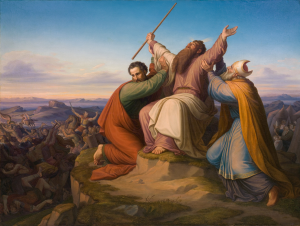
This is an archive of Torah and Haftarah readings for Parashat b'Shalaḥ (Exodus 13:17-17:16), the fourth parashah in Sefer Shemot according to the annual Torah reading cycle. The haftarah reading for Parashat b'Shalaḥ is Judges 4:4-5:31. Parashat b'Shalaḥ is preceded by parashat Parashat Bo (Exodus 10:1-13:16). Parashat Yitro (Exodus 18:1-20:22) follows it. Click here to contribute a novel translation of a Torah or Haftarah reading you have prepared for Parashat b'Shalaḥ. Filter resources by Name Filter resources by Tag Filter resources by Category Filter resources by Language Filter resources by Date Range This piyyuṭ, bearing the acrostic signature “Samuel,” is traditionally recited in the communities of Babylonia and India as a petiḥa, or opening poem, before the Song of the Sea. It is also sung on Shabbat Shira, the Sabbath where we read the Song of the Sea in public. This translation is an attempt to preserve the original meaning as well as the rhyme scheme and poetic form. Categories: Tags: Contributor(s): Originally written by Yehuda haLevi for the seventh day of Pesaḥ, Yom le-Yabasha — a celebration of the crossing of the Sea of Reeds and the establishment of the covenant as signified by the circumcision and tsitsit — it quickly became a beloved piyyut on that occasion and more. Categories: Tags: Contributor(s): This is a pizmon for Shabbat Shirah (Parashat B’Shalaḥ) by an unknown author. The text is as transcribed from the pizmonim included in the siddur משמרת הקדש: קול שומר שבת Mishmeret haQodesh: Qol Shomer Shabbat (Pisa 1821), p. 117. Categories: Tags: Contributor(s): This pizmon, signed with the name Moshe but of otherwise unclear attribution, is recited in the Sephardic communities of Rhodes and Istanbul (and nowadays in Seattle) before the open ark on Shabbat Shirah and the seventh day of Pesaḥ. The main Hebrew text of the first and last two stanzas are as found in the Seattle Sephardic community’s 2002 Siddur Zehut Yosef (as well as the Gözlem Kitap press in Istanbul’s 2011 Şaloş Regalim), with footnotes marking differences in the Shirei Yisrael B’Erets HaḲedem (published in Istanbul in 1921) and the Yeshiva University Library diwan of Baruch Moshe Moreno, written by hand in the monastery neighborhood of Tiberias in 1867 (YU MS. 1126). In between are three additional non-rhyming stanzas found in substantially different form in the other two sources but not recited in modern Sephardic communities. Categories: Tags: Contributor(s): This pizmon, signed with the name Moshe but of otherwise unclear attribution, is recited in the Sephardic communities of Rhodes and Istanbul (and nowadays in Seattle) before the open ark on Shabbat Shirah and the seventh day of Pesaḥ. The main Hebrew text of the first and last two stanzas are as found in the Seattle Sephardic community’s 2002 Siddur Zehut Yosef (as well as the Gözlem Kitap press in Istanbul’s 2011 Şaloş Regalim), with footnotes marking differences in the Shirei Yisrael B’Erets HaḲedem (published in Istanbul in 1921) and the Yeshiva University Library diwan of Baruch Moshe Moreno, written by hand in the monastery neighborhood of Tiberias in 1867 (YU MS. 1126). In between are three additional non-rhyming stanzas found in substantially different form in the other two sources but not recited in modern Sephardic communities. Categories: Tags: Contributor(s): “Shirat Miriam and Devorah / Uri, Uri” (Song of Miriam, Song of Deborah / Rise up, Rise Up) was first published in 2024, as the second of four piyyutim published through the Diwan Ashira Project by Ephraim Kahn. Categories: Tags: 2023-2025 Israel–Hamas war, 21st century C.E., 58th century A.M., Devorah, Miriam, פיוטים piyyuṭim, רשויות reshuyot, פרשת בשלח parashat B'shalaḥ, שבת שירה shabbat shirah, שירת הים Shirat haYam, זמירות zemirot Contributor(s): |
![the Open Siddur Project [logo]](https://opensiddur.org/wp-content/uploads/2018/09/Open-Siddur-Project-Logo-2016.svg)