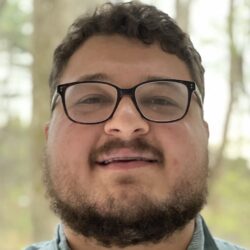
From a family of musicians, Isaac Gantwerk Mayer believes that creative art is one of the most powerful ways to get in touch with the divine. He composes music and poetry in Hebrew and English. (He also translates and transcribes Hebrew and Aramaic texts, adding niqqud and t'amim as needed.) Isaac runs a Jewish music transcription service, which will transcribe and set any Jewish music in any language, recorded or written. Contact his service on Facebook or via his music blog.
Filter resources by Category
After the Aliyot | Minḥah | 🌐 Agunah Day (Adar 13) | During the Aliyot | Barekh | Barkhu | Blessings After Eating | Birkat Kohanim | Bnei (Bar/Bat) Mitsvah & Other Birthday Prayers | 🇺🇸 National Brotherhood Week | Cantillation Systems | Slavery & Captivity | Conflicts over Sovereignty and Dispossession | Counting Days | Daniel | Divrei Hayamim (Chronicles 1 & 2) | Drought & Wildfire | the Dry Season (Spring & Summer) | Earth, our Collective Home & Life-Support System | Earthquakes & Tsunamis | 🇺🇸 Election Day (1st Tuesday after November 1st) | Elections & Voting | Rosh Ḥodesh Elul (אֶלוּל) | Epidemics & Pandemics | Extracanonical Megillot | Ezra-Neḥemiah | Pogroms & Genocide | 🇺🇸 George Washington's Birthday Readings | Ḥanukkah | Hateful Intolerance, Prejudice, and Bigotry | Historical Writings | Holocaust & Genocide Memorial Day Readings | 🌐 Holocaust Remembrance Day (January 27th) | Imminent Communal Danger & Distress | Incantations, Adjurations, & Amulets | 🇺🇸 Independence Day Readings | 🌐 International Workers' Day (May 1st) | 🌐 International Workers' Day Readings | Iyov (Job) | Ḳaddish | ◆ Ketuvim (Writings) | Kristallnacht (9-10 November, 16 Marḥeshvan) | 🇺🇸 Labor Day (1st Monday of September) | Learning, Study, and School | Magid | 🇮🇱 Yitsḥaq Rabin Memorial Day (4 November, 12 Marḥeshvan) | 🇮🇱 Medinat Yisra'el (the State of Israel) | 🇺🇸 Memorial (Decoration) Day Readings | Mishlei (Proverbs) | Modern Miscellany | Modim d'Rabbanan | Motsaei Shabbat | Mourning | Nirtsah | Parashat b'Shalaḥ | Haggadot for the Seder Leil Pesaḥ | 7th Day of Pesaḥ | Pesaḥ Sheni | Purim | Purim Qaṭan Readings | Purim Sheni Readings | Reading Schedules | 🇺🇸 Days of Remembrance of the Victims of the Holocaust (28-29 April) | Rosh haShanah (l’Maaseh Bereshit) | Rosh haShanah la-Behemah | Rosh haShanah la-Ilanot (Tu biShvat) | Rosh Ḥodesh | Seder Akhilat haSimanim | Seder intro | Seder Leil Pesaḥ Sheni | Sefirat ha-Hin | Sefirat ha'Nesekh | Separation | Shemini Atseret | Shirat ha-Yam | Shiv'ah b'Adar | Shulḥan Orekh | Sigd Festival | Simḥat Torah | Dangerous Storms & Floods | Sukkot | Symbolic Foods | Tehilim (Psalms) | Terror | 🇺🇸 Thanksgiving Day Readings | Theurgy | Tishah b'Av | 🌐 Transgender Day of Visibility (March 31st) | Travel | Tsom Gedalyah | Tu b'Av | Well-being, health, and caregiving | the Wet Season (Fall & Winter) | 🇮🇱 Yom ha-Atsma'ut (5 Iyyar) | 🇮🇱 Yom haShoah (27 Nisan) | 🇮🇱 Yom haZikaron Readings | Yom Kippur | Yom Kippur Readings | Yom Meturgeman | Yom Simḥat Kohen
Filter resources by Tag
Filter resources by Name
Filter resources by Language
Filter resources by Date Range
Resources filtered by CATEGORY: “🇮🇱 Yom haShoah (27 Nisan)”
(clear filter)
Contributed by:
Isaac Gantwerk Mayer
A full qedushta cycle, in the Qallirian style, for the Shabbat between Yom haShoah and Yom ha-Atsma’ut, referred to in the recently published Israeli Reform siddur Tefilat haAdam as “Shabbat Tequmah” (the sabbath of renewal). Partially based on the structure of the qedushta for Shabbat haGadol, the culmination of this qedushta is an azhara, a poetic retelling of the entire Megilat ha-Atsma’ut.
Contributed by:
Isaac Gantwerk Mayer
There’s a lot of controversy over Yom haShoah as a date. One of the key issues is this: traditionally, the ways Jews mourn communal tragedies is through establishing a fast day. It’s forbidden to fast during the month of Nisan. It’s hard to pick any specific date to commemorate a tragedy as enormous as the Shoah, but one which seems appropriate to me would be 16 Marḥeshvan, the anniversary of Kristallnacht, the November Pogrom. This piyyut is a seliḥah for Kristallnacht, to be recited on 16 Marḥeshvan (or 15 Marḥeshvan on years like 5782 where the sixteenth falls on a Thursday).
Contributed by:
Isaac Gantwerk Mayer
The most traumatic event in recent Jewish history is the Holocaust. At this time, the survivors of the camps are aging, and in the lifespan of people alive today it is likely that the last survivor will die. We say we must never forget what happened during the Holocaust, but if we think of it as a tragedy that happened to our ancestors we will forget. But it has been 3000 years since the Exodus from Egypt, and the Haggadah keeps its history vivid and alive. We are taught that in each and every generation we are to think of ourselves as having been slaves in Egypt. May it be that just as we never forgot the wonders of the Exodus, so too we never forget the horrors of the Holocaust, and continue to strive that such horrors may never happen again until all live in freedom and peace.
![the Open Siddur Project [logo]](https://opensiddur.org/wp-content/uploads/2018/09/Open-Siddur-Project-Logo-2016.svg)


